

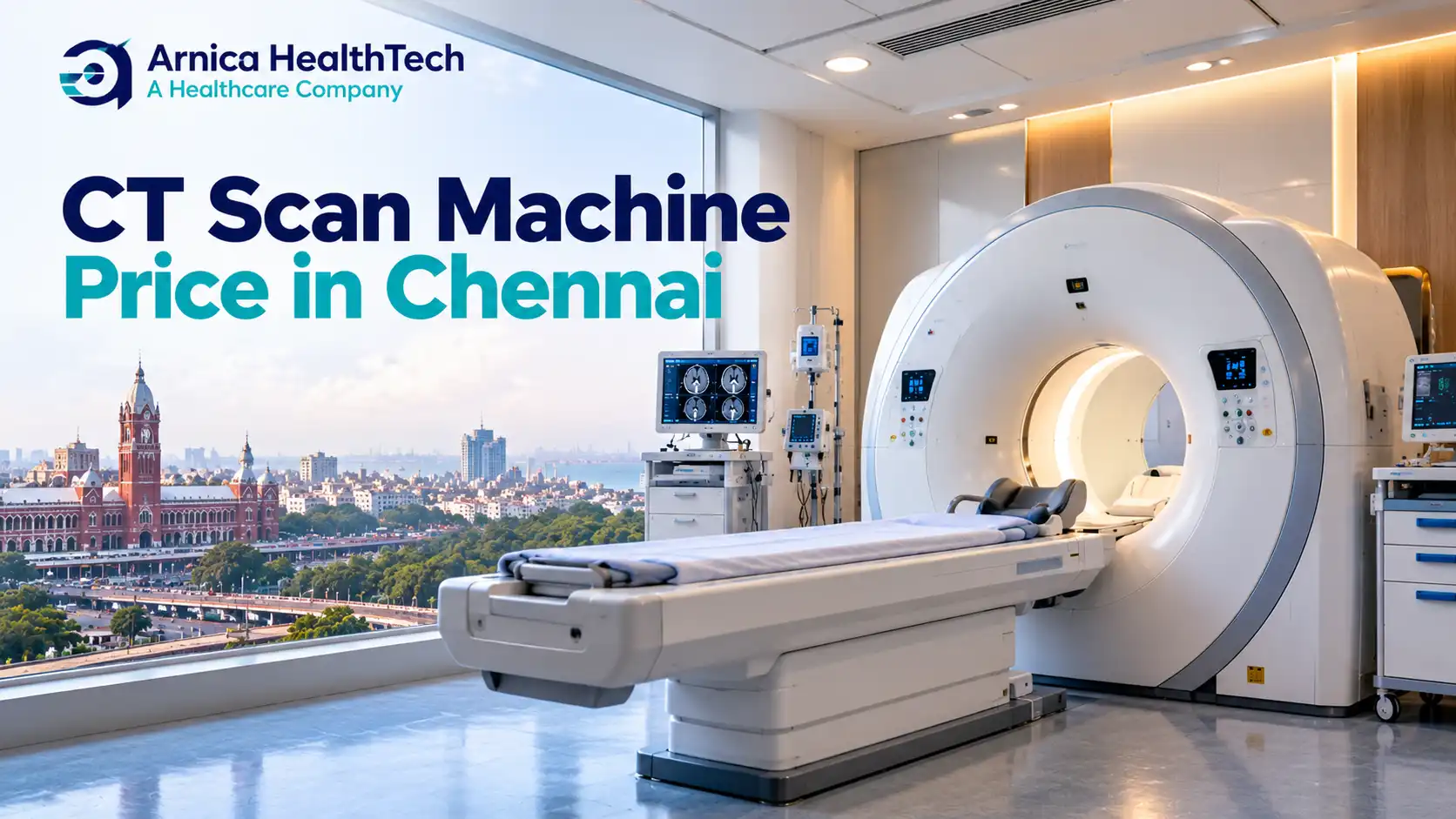
The honest answer to the CT scan machine price in Chennai is that the machine costs the same here as anywhere in India, and the final bill depends on what you choose and where you install it. This guide separates the two so that you can budget with confidence.
What a CT Scan Machine Costs in Chennai
CT scan machine prices in India broadly fall between 30 lakhs and 4 crores in 2026. Slice count, make and condition explain most of the spread.
- 16 slice: new units usually start around 60 to 70 lakhs, while refurbished machines are available from roughly 30 to 45 lakhs.
- 32 slice: pricing generally runs from about 70 lakhs to 1.2 crores, with brand and condition as the biggest swing factors.
- 64 slice: refurbished units from makes such as Siemens or GE are commonly available between about 75 lakhs and 1.3 crores.
- 128 slice and above: advanced systems for cardiac and neuro imaging can exceed 2 crores when new.
You can read the national breakdown on our CT scan machine price in India page. For a sense of how refurbished pricing works for Siemens units, see our guide to refurbished CT scan machine cost for diagnostic centres.
Who Buys a CT Scanner in Chennai, and What They Need
Chennai buyers fall into three broad groups, and each should look at a different part of the price range.
Established hospitals adding capacity
Hospitals with queues for CT often add a second scanner. They value speed and CT angiography capability, which points toward 64 slice systems and strong service contracts.
Standalone diagnostic centres
A standalone centre depends on referrals from local doctors. A 16 or 32 slice scanner, new or refurbished, usually delivers the right balance of capability and cost for routine head, chest, abdomen and spine work.
Clinics and hospitals in smaller Tamil Nadu towns
Tier-2 and tier-3 towns increasingly want in-house CT rather than sending patients to the city. Refurbished systems make this possible without a very large investment. If you are looking at a regional site, our Eclos CT scan in Coimbatore page shows a comparable setup in the state.
Climate Is a Cost Factor in Chennai
Chennai is hot for much of the year, humid throughout and affected by heavy rain during the northeast monsoon. A CT scanner is sensitive to heat and moisture, so climate is a genuine part of the price conversation.
- Cooling capacity: the scan room and equipment room need properly sized air conditioning with backup, because a gantry that overheats stops scanning.
- Humidity control: moisture can damage electronics and connectors over time. Good sealing and dehumidification protect them.
- Water ingress: rooms on lower floors or near drainage lines should be checked for flooding risk during heavy rain.
- Dust and salt air: coastal air is harder on equipment than inland air, so filters and regular cleaning matter.
Spending a little more on climate control at the start costs far less than repeated service calls later.
Refurbished CT Scan in Chennai: How to Judge Quality
A refurbished scanner can match a new one in daily performance when it is rebuilt properly. Three questions separate a good offer from a poor one. What was replaced and tested during refurbishment? What is the X-ray tube history? And what does the warranty actually cover? Our refurbished Hitachi CT scan range is a good starting point for centres that want a dependable system at a lower entry cost.
Choosing Between Brands
Siemens, GE, Hitachi and other makes are all in use in Indian centres. Brand preference matters less than three practical points: how many units are installed in India, how close the service engineers are, and how easily spare parts can be sourced. Ask each supplier for the names of centres using the same model and speak to them about uptime and support.
Running Costs You Should Plan For
- X-ray tube replacement, which depends on workload.
- Annual or comprehensive maintenance contract.
- Electricity for the scanner and for cooling, which is a larger share in a hot climate.
- Contrast media and injector consumables.
- Technologist and radiologist costs.
Room, Power and Regulation
A CT room needs radiation shielding, a separate control area and stable power with a UPS and voltage regulation. Because the scanner uses ionising radiation, installation and operation fall under national radiation safety requirements overseen by AERB. Confirm the current registration process with your supplier and the regulator before you place an order, and plan the shielding design before construction begins.
Comparing the Real Cost Over Three Years
A scanner that looks cheap in year one can be the most expensive by year three. A simple three-year comparison keeps the decision honest. For each quotation, add the purchase price, the room and installation cost, the first three years of maintenance, the expected tube replacement and the electricity load. Then subtract nothing for hopes about volume. If the numbers still work with a cautious scan count, the project is sound.
This method often favours a refurbished system with a strong service plan over a new system with a thin one, and it sometimes favours a new system where the manufacturer warranty covers years of expensive parts. Either way, the answer comes from the arithmetic and not from the brochure.
Annual Maintenance or Comprehensive Cover
Maintenance contracts come in two broad forms. An annual maintenance contract covers scheduled servicing and labour, while parts are charged separately. A comprehensive contract also covers parts, often with defined exclusions such as the X-ray tube. In a humid city like Chennai, where electronics face more stress, many buyers prefer comprehensive cover for the first years. Read the exclusions carefully and ask for the response time in writing, because a contract that promises everything but responds slowly protects nothing.
Power Quality and Backup in Chennai
CT scanners are sensitive to voltage dips, surges and poor earthing. A stabiliser or conditioner, a properly rated UPS and a tested earthing system protect the tube and the electronics. Where supply interruptions are common, a generator with automatic changeover keeps scheduled and emergency scans running. These are small items next to the price of the scanner, yet they decide how often the machine goes down.
Installation Timeline
A realistic timeline has four phases. First comes the site survey and quotation comparison. Second is room preparation, including shielding, air conditioning, electrical work and flooring. Third is delivery, installation and commissioning. The last phase covers acceptance testing, application training and the regulatory steps needed before patient use. Room preparation usually takes longer than the machine itself, so start it early and agree the shielding design before walls go up.
Staffing and Reporting
You need trained technologists, a reporting radiologist and a plan for after-hours reports. Many Chennai centres combine in-house radiologists with teleradiology so that referrers receive reports quickly. Decide this before the scanner arrives, because the report is what the referring doctor actually receives and judges.
A Typical Scenario: A New Centre Choosing Its First CT
Consider a new centre near a cluster of clinics and a few small hospitals. Its referrers are mainly physicians, surgeons and neurologists, and the owner has a limited budget. The sensible starting point is a 16 or 32 slice scanner, a well-built room with strong cooling and a comprehensive service contract for the first years. This approach keeps the capital cost under control, gets the centre scanning quickly and leaves space to add a higher slice system or a second modality when volumes justify it.
The owner who instead buys the largest scanner available often finds that the extra capability sits unused while the loan instalments continue. Matching the machine to the referral mix is the most reliable way to protect the budget.
Planning for Growth
A CT scanner bought now should still suit the centre in five years. Ask whether the software can be upgraded, whether parts for the model will remain available and whether the supplier supports it across India. Keep a little extra floor area and electrical capacity in the design. It costs little at the start and avoids a rebuild if you later upgrade or add another modality.
Mistakes to Avoid
- Choosing a scanner before checking whether the room can handle its heat load.
- Ignoring flood and water risk in the planned room.
- Buying on price alone without tube history or references.
- Skipping a comprehensive service discussion in a humid climate.
- Leaving no space or power capacity for a later upgrade.
Questions to Ask Before You Sign
- What exactly was refurbished, and can I see the documentation?
- What is the tube history, and what will a replacement cost?
- Which centres in India use the same model today?
- How fast can an engineer reach Chennai, and where are parts stocked?
- What does the warranty exclude?
- Is installation, shielding guidance and training included in the price?
How to Compare Chennai Quotations
- Ask for model, year, slice count and tube history in writing.
- Check that installation, shielding guidance and training are included.
- Compare warranty length and exclusions.
- Ask how quickly an engineer can reach Chennai and where spare parts are stocked.
- Speak to an existing owner of the same model.
Talk to Arnica Healthtech About Your Chennai Project
Arnica Healthtech supplies, installs and services refurbished CT scan machines across India. Share your expected volume, room size and budget, and we will recommend suitable options with an itemised quotation. Call +91 95605 07877 or write to arnicahealthtech@gmail.com.
