

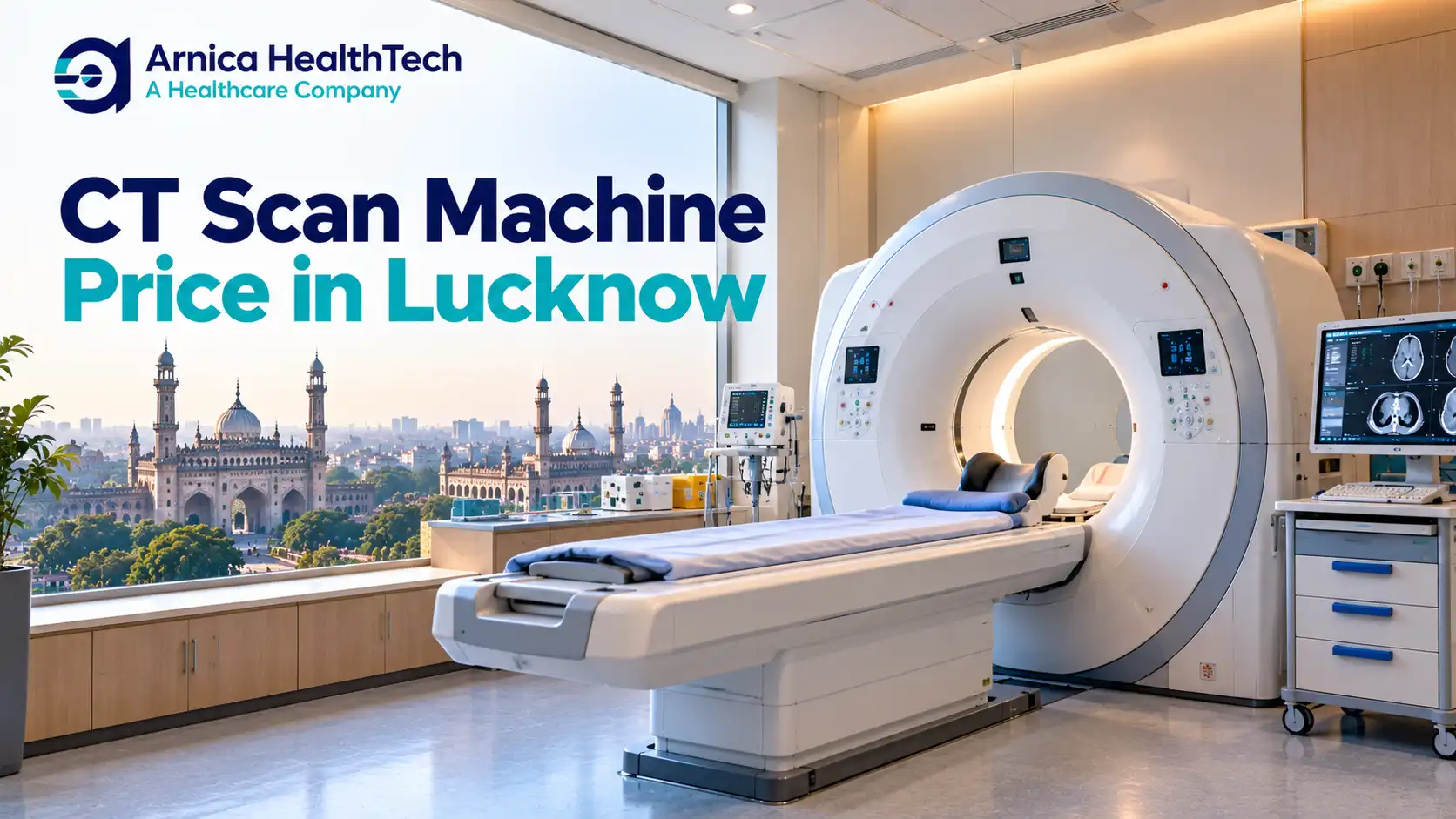
Buyers in Lucknow often ask for one price for a CT scan machine, and the right answer is a range with reasons attached. The scanner itself is priced nationally. What differs in Lucknow is the kind of centre you are building, the service support within reach and the conditions the machine must run in.
CT Scan Machine Price Range for Lucknow Buyers
In 2026, CT scan machine prices in India generally fall between 30 lakhs and 4 crores. The figures below show how slice count and condition shape the price.
| Slice count | New | Refurbished |
|---|---|---|
| 16 slice | Starts around 60 to 70 lakhs | Roughly 30 to 45 lakhs |
| 32 slice | About 70 lakhs to 1.2 crores | Depends on make and condition |
| 64 slice | Higher, depending on brand | About 75 lakhs to 1.3 crores for Siemens or GE units |
| 128 slice and above | Can exceed 2 crores | Limited availability |
For the national picture, see our CT scan machine price in India page. These are guide ranges, so always confirm with an itemised written quotation.
Why Lucknow Is a Strong Market for a New CT Scanner
Lucknow combines large public institutions, private hospitals and a growing network of diagnostic centres. Patients come from smaller towns across the region because specialist referrals and imaging are concentrated in the city. A centre that offers reliable CT with quick reporting can draw from a wide catchment rather than just its own neighbourhood.
The same demand also means competition, so a new centre should be clear about what it will do better than the others: faster reports, longer hours, friendlier service or a particular specialty such as chest, neuro or emergency imaging.
Service Reach Matters More Than a Small Price Difference
For a Lucknow centre the most important question is often not price but who will fix the machine and how fast. A scanner that is down for a week during a busy month costs more than the difference between two quotations. Ask each supplier where their engineers are based, how quickly they can reach Lucknow and where they stock critical parts. Ask for the names of centres in Uttar Pradesh that use the same model and speak to them about uptime.
Choosing a Reliable Supplier
The supplier you choose will matter as much as the machine. A short list of checks protects you from poor refurbishment and weak support:
- A documented refurbishment process, with a list of parts replaced and tests performed.
- Written tube history and software version.
- A clear warranty with stated exclusions.
- Installed references you can contact.
- Application training for your technologists at handover.
Our guide to the best refurbished CT scan machine dealers in India explains these checks in more detail.
New or Refurbished for a Lucknow Centre
A new scanner brings the latest software and a manufacturer warranty at the highest price. A refurbished scanner, when rebuilt properly, delivers the same everyday imaging at a far lower cost and often with shorter delivery. For most standalone centres in the city, refurbished equipment is the practical choice, because it protects cash for the room, the staff and the first months of operation. Hospitals with large capital budgets and long planning horizons may prefer new systems.
The refurbished Hitachi CT scan range and the Hitachi Scenaria CT scan are worth reviewing if you want a dependable platform with a good record in Indian centres.
Conditions in Lucknow That Affect the Machine
Summers in Lucknow are hot and dry, the monsoon brings humidity, and winters bring cold mornings and fog. A CT scanner needs a steady room temperature year round, so the air conditioning plan should be sized for peak summer heat with a backup unit. Dust is another concern, and filters and regular cleaning protect the detectors and cooling fans. Power supply can fluctuate, so voltage regulation, a UPS and a generator with automatic changeover are worth including in the budget from the start.
Room Requirements and Regulation
A CT room needs radiation shielding in the walls, door and viewing window, a separate control area and a suitable floor. Because CT uses ionising radiation, installation and operation follow national radiation safety requirements overseen by AERB. Confirm the current registration process with your supplier and the regulator before you place an order, and agree the shielding design before construction begins.
Running Costs to Budget
- X-ray tube replacement, which depends on how many scans you perform.
- A maintenance contract, annual or comprehensive.
- Electricity for the scanner and the cooling load.
- Contrast media, injector consumables and patient items.
- Technologists, a reporting radiologist and radiation safety arrangements.
Building Referrals Beyond the City
Because patients travel to Lucknow for imaging, a centre can grow by building relationships with doctors in nearby towns as well as those in the city. Visit clinics, explain what your scanner can do, and offer clear scheduling so that out-of-town patients can book a visit without losing a day. A centre that gives a precise appointment time, scans promptly and delivers the report the same day earns repeat referrals from doctors who know their patients will not be sent back and forth.
Turnaround Time Is Part of the Product
Referring doctors and patients both judge a CT centre by how quickly the report arrives. Plan the reporting workflow before the scanner is installed. Decide whether reports will come from an in-house radiologist, a visiting radiologist or a teleradiology service, and set a target turnaround for routine and urgent studies. Digital delivery of images and reports to patients and doctors reduces repeat visits and makes your centre easier to recommend.
Phasing the Investment
You do not have to buy everything at once. A common sensible path is to begin with a 16 or 32 slice refurbished scanner, build volume for a year and then decide on an upgrade or an MRI machine with real data in hand. Design the room so that the second step does not mean demolition: leave space, electrical capacity and cooling headroom for what comes next.
A Realistic Installation Timeline
Allow time for each stage rather than hoping for a single quick fix. The site survey and supplier selection come first. Room construction and shielding follow, along with air conditioning and electrical work. The scanner is delivered once the room is ready, then installed, calibrated and tested. Application training for technologists and the regulatory steps for radiation safety complete the process before patients are scanned. Room preparation normally takes longer than the machine itself, so start it early.
Staffing the Centre
A working CT centre needs at least two trained technologists so the room does not close when one is absent. It also needs a reporting radiologist, front-desk staff who can manage scheduling and contrast screening, and a person responsible for radiation safety. Ask the supplier for application training at handover and a follow-up visit after the first weeks, when real questions emerge.
Matching the Scanner to Your Case Mix
The mix of studies you expect should drive the slice count more than any brochure does. A centre that mostly performs head, chest and abdomen scans for physicians and surgeons will be well served by a 16 or 32 slice system. A centre that expects emergency and trauma referrals, vascular studies or cardiac work will benefit from a faster 64 slice machine. A centre aimed at oncology follow-up needs reliable, repeatable image quality and a service plan that keeps downtime short.
Write down your expected top ten studies and the number of patients per day before you speak to suppliers. A supplier who asks about your case mix before quoting is usually one who will support you after the sale.
Common Mistakes Lucknow Buyers Make
- Choosing on the lowest quotation without asking about engineer response time.
- Ignoring dust and heat when designing the room.
- Skipping voltage protection and backup power.
- Buying a higher slice count than the referral mix will use.
- Leaving reporting arrangements to be sorted out after installation.
Questions to Put to Every Supplier
- Can I see this exact scanner, or an identical working installation, before I pay?
- What is the tube history, and what would a replacement cost?
- Which centres in Uttar Pradesh use this model?
- What does the warranty cover, and what does it leave out?
- Who will train my technologists, and when?
How to Compare Lucknow Quotations
- Request the model, year, slice count and tube history in writing.
- Confirm what is included: delivery, installation, shielding guidance and training.
- Check warranty length and exclusions.
- Ask how fast an engineer can reach Lucknow.
- Speak to an existing owner of the same model.
Talk to Arnica Healthtech About Your Lucknow Project
Arnica Healthtech supplies, installs and services refurbished CT scan machines across India. Tell us your expected volume, room size and budget, and we will suggest suitable options with an itemised quotation. Call +91 95605 07877 or write to arnicahealthtech@gmail.com.
