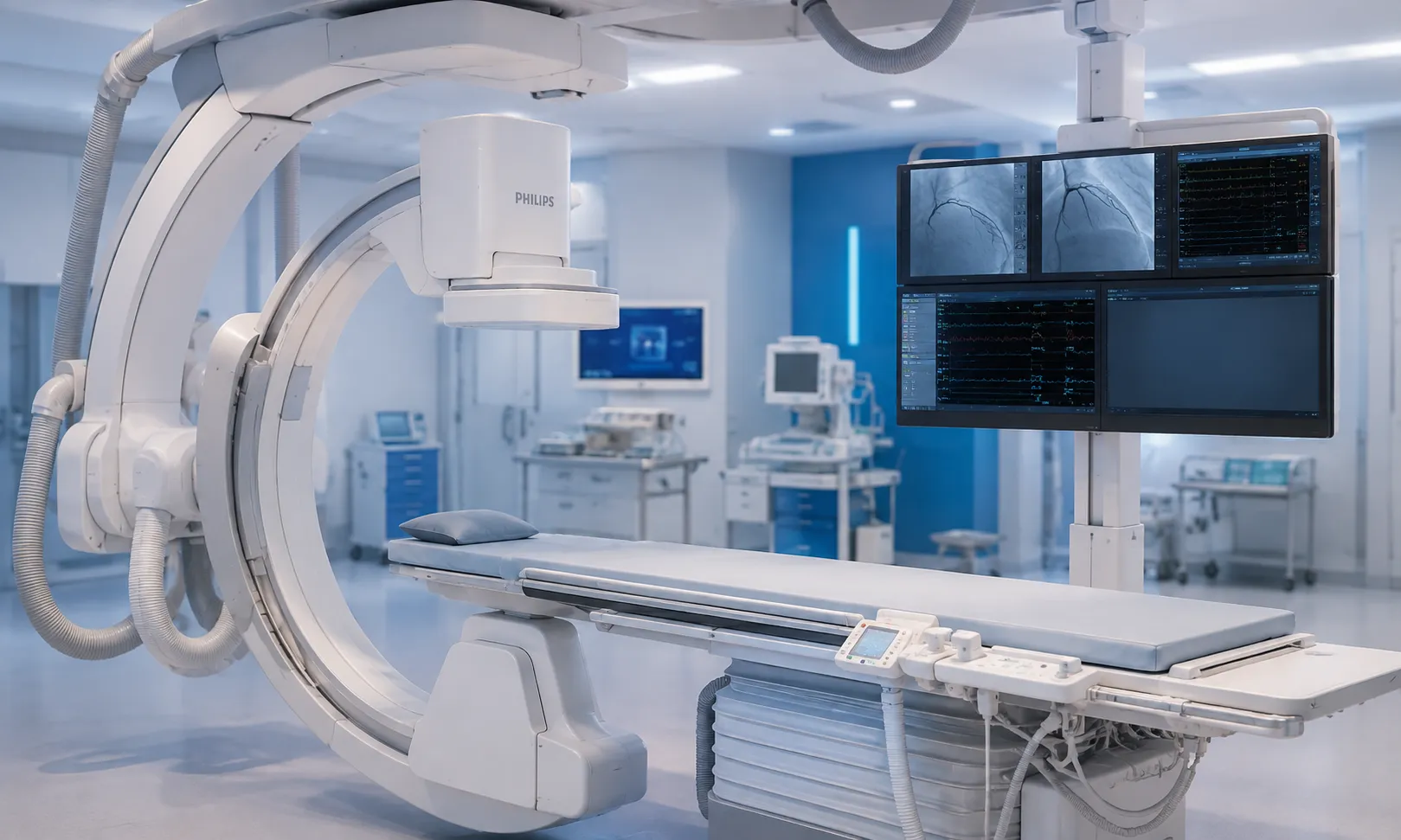
If you're planning to bring cardiac catheterization in house, you've probably already noticed that cath lab pricing is one of the hardest numbers to pin down online. Search for it and you\'ll mostly find scattered supplier listings with no context, a directory quote here, a "call for price" button there, and nothing that actually tells you what drives the number up or down. For a piece of equipment this expensive, that\'s not good enough.
This guide breaks down what a refurbished cath lab machine genuinely costs in India in 2026, what a new system costs by comparison, and the parts of the budget people usually forget until the invoice shows up.
Not sure whether your facility needs an FD10 or an FD20, or what the full setup will run you?
Talk to our team and we'll walk through the numbers with you, no pressure, just a straight answer.
What a Cath Lab Actually Is, Quickly
A cath lab, short for catheterization laboratory, is a specialised imaging room built around a C-arm X-ray system that lets a cardiologist see live, moving X-ray images while guiding a catheter through a patient\'s blood vessels. It\'s the room where angiography (checking for blockages), angioplasty (opening a blocked artery with a balloon or stent), and pacemaker implants happen, all without open surgery. If you\'ve ever heard someone say a family member \"got a stent put in," that procedure almost certainly happened in a room like this.
The machine at the centre of it all is usually called a cardiac angiography system or an interventional X-ray system. Philips' Allura Xper FD10 and FD20 are two of the most common models you\'ll find in the Indian refurbished market, and they\'re where most of this guide focuses.
Refurbished Cath Lab Price by System
Pricing depends heavily on which system you\'re looking at, whether it\'s monoplane or biplane, and the condition of the X-ray tube and detector. Here\'s a realistic breakdown based on current market listings and deal data we track.
Philips Allura Xper FD10 (Monoplane)
The FD10 is the more accessible entry point into Philips\' cath lab range, built for standard cardiac and vascular interventions. Refurbished monoplane FD10 units in India typically run ₹1.1 crore to ₹1.5 crore, depending on tube condition, detector generation, and year of installation.
Philips Allura Xper FD10/10 (Biplane)
The biplane version, which uses two imaging chains instead of one, is a step up for centres doing more complex procedures like electrophysiology or paediatric cardiology, where getting two simultaneous angles matters. Refurbished biplane FD10/10 systems generally fall between ₹1.5 crore and ₹1.9 crore.
Philips Allura Xper FD20
The FD20 uses a larger flat detector and a more powerful generator, which makes it better suited for high-volume centres or those handling a broader mix of cardiac, vascular, and neuro-interventional cases. Refurbished FD20 units typically sell for ₹1.4 crore to ₹2 crore, with well-maintained recent-generation units sitting toward the top of that range.
New Cath Lab Systems
For comparison, a brand new cath lab system in India, Philips or otherwise, generally starts around ₹2.5 crore and can cross ₹4 crore for high-end biplane configurations with the latest imaging software. That gap is exactly why so many mid-sized diagnostic and cardiac centres go refurbished, the clinical capability is close, but the capital outlay is roughly half.
For a broader sense of how these numbers fit into your total equipment plan, our full cost breakdown of setting up a diagnostic centre in India is worth reading alongside this one, since a cath lab is rarely the only big-ticket item on the list.
What Actually Moves the Price
Two FD20 units can be priced 20 to 30 percent apart, and honestly, most buyers never find out why until they\'ve already signed something. A few things worth checking before you compare quotes:
X-ray tube condition is the biggest factor.
Cath lab tubes work harder than CT or MRI components because interventional procedures can run long, sometimes over an hour for complex cases. A tube with strong remaining life will always cost more upfront, but it saves you a very expensive replacement down the line.
Detector generation affects both image quality and price.
Older flat detectors produce noticeably softer images at higher dose. If your centre plans to handle complex interventions, ask specifically which detector generation is installed, not just the model name.
Monoplane vs biplane changes the whole budget.
Biplane systems cost more to buy and more to maintain, but they\'re genuinely necessary for certain procedure types. Don\'t buy biplane capability you\'ll never use, and don\'t undersize if your cardiologist actually needs it.
Software and workflow tools matter more than people expect.
Features like Philips\' StentBoost or DoseWise aren\'t just marketing terms, they affect image clarity during a stent placement and how much radiation your staff and patients are exposed to over years of use.
Installation, calibration, and documentation support change what you\'re really paying for.
A supplier who handles proper installation, testing, and commissioning as part of the deal is worth more than one offering a slightly lower number with none of that included.
The Part of the Budget People Forget: Civil Work and Licensing
This is where cath lab budgeting gets genuinely different from buying an MRI or CT scanner, and it\'s the part that catches new centres off guard the most.
A cath lab room needs proper radiation shielding, lead-lined walls, a lead-lined door, and often a lead-glass viewing window for the control room, none of which is optional. Depending on room size and existing structure, shielding and civil work typically adds ₹15 lakhs to ₹30 lakhs on top of the machine cost. You\'ll also need appropriate HVAC for the equipment room, since these systems generate real heat and are sensitive to temperature swings, trust us, an overheated cath lab having a bad day mid-procedure is not a situation anyone wants.
On the regulatory side, a cath lab falls under AERB (Atomic Energy Regulatory Board) licensing requirements, the same body that governs CT scanners, since it\'s an X-ray emitting device. You\'ll need to appoint a Radiation Safety Officer, get the room design approved before installation in many cases, and complete type approval documentation for the specific system. A supplier with real experience installing cath labs in India, not just CT and MRI, will know this process well enough to walk you through it rather than leaving you to figure it out with the regulator directly.
If you want a closer look at how refurbished equipment procurement generally works in India, our guide on what to check before choosing a refurbished CT scan machine dealer covers vetting questions that apply just as much to a cath lab supplier.
Running Costs Nobody Mentions Upfront
The purchase price is a one-time number. Running a cath lab is a recurring cost, and it\'s worth planning for honestly rather than finding out the hard way.
Annual maintenance contracts for a cath lab typically run higher than for a CT or MRI machine, largely because of the tube demands and the more complex imaging chain, often somewhere in the range of ₹15 lakhs to ₹28 lakhs a year depending on system complexity and whether it\'s monoplane or biplane. Tube replacement, when it eventually comes due, is a significant expense and worth asking your supplier for an honest estimate on before you buy, not after the tube starts showing wear.
Staffing is the other recurring cost that\'s easy to underestimate during the planning phase. Beyond the interventional cardiologist, you\'ll need a trained cath lab technologist and nursing staff comfortable with interventional procedures, and that expertise doesn\'t come cheap in most Indian cities right now.
Questions to Ask Before You Buy
A few direct questions before signing anything can save you a lot of trouble later:
- Ask for documented tube usage hours, not a verbal assurance that it\'s \"in good condition.\"
- Confirm whether the quoted price includes installation, calibration, and commissioning, or whether those are separate line items.
- Clarify what warranty coverage applies, parts, labour, or both, and get the exact duration in writing.
- Ask whether the supplier assists with AERB documentation and RSO appointment, or whether that\'s entirely your responsibility.
- Find out how many cath lab installations the supplier has actually completed in India. This is genuinely different equipment from CT and MRI, and experience with the specific system matters.
You can also cross-check general refurbished equipment red flags in our guide on refurbished versus second-hand medical equipment, which explains the difference between a properly refurbished system and one that\'s just been resold with a fresh coat of paint.
Final Word
A cath lab is one of the biggest single investments a cardiac or diagnostic centre will make, and it\'s not a decision to base on the first quote that lands in your inbox. Tube life, detector generation, and whether the supplier actually knows this equipment well enough to guide you through shielding and AERB compliance matter far more than the sticker price alone. Take the time to ask the right questions, and the machine will pay for itself in the procedures it enables for years to come.
If you\'d rather skip the back and forth and get a straight number for your specific setup, reach out to our team and we\'ll help you find the right cath lab system for your centre, your patient volume, and your budget.