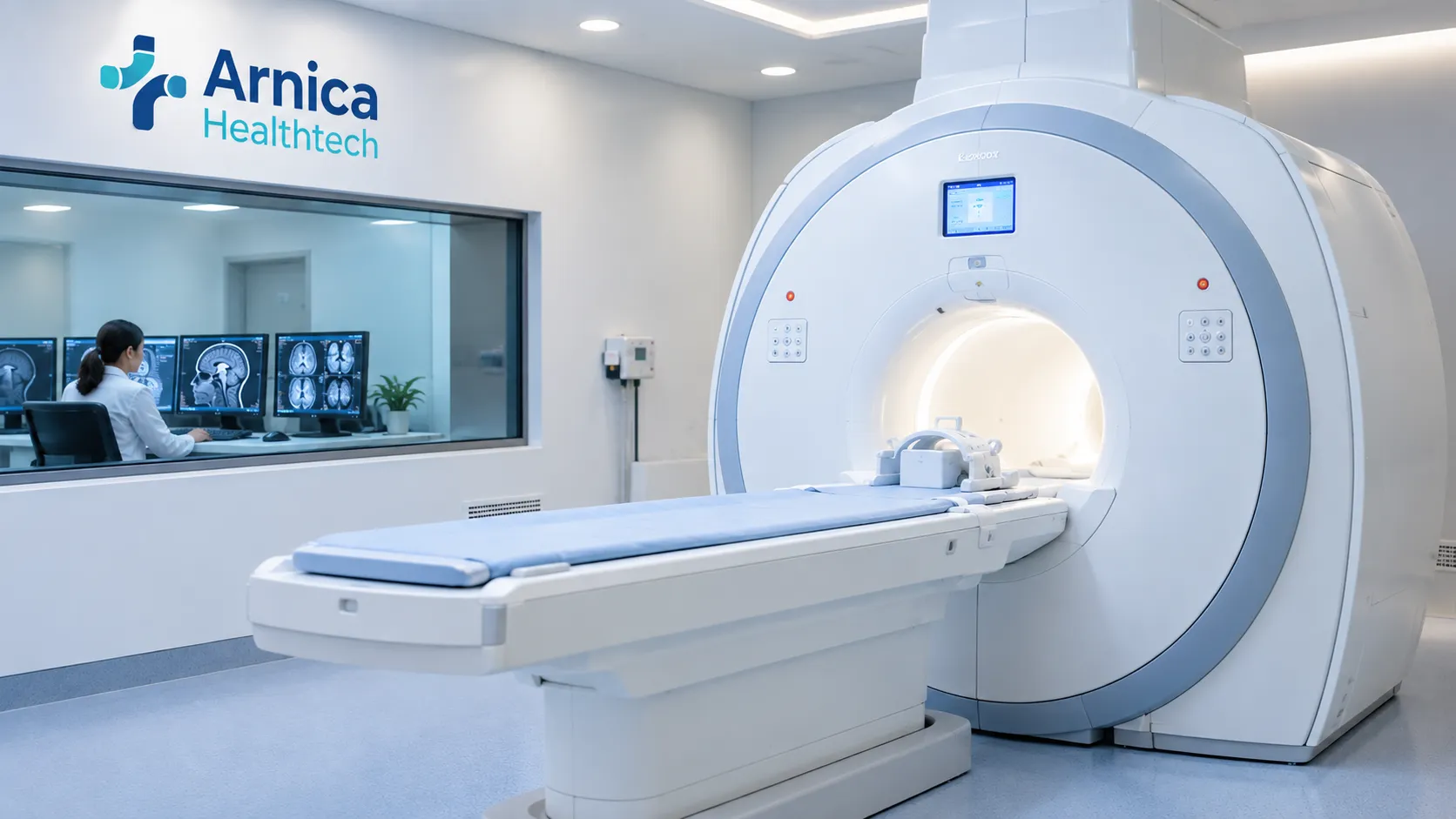
This guide gives you a way to reach that answer for your own hospital. It covers what to decide first, which specifications deserve your attention, how new and refurbished systems compare, and what to ask before anyone signs anything.
The Short Answer, Before the Long One
The right MRI machine is the one that fits your case mix, fits your building, and is supported by a service team that can reach you quickly. A system that scores well on only one of those three will disappoint you in year two.
Most bad purchases happen when a hospital falls in love with one attribute, usually field strength or a familiar brand name, and lets the other two slide. The sections below help you keep all three in view.
Three Hospitals, Three Different Answers
Before comparing machines, decide which kind of hospital you are buying for. These three profiles are simplified, but they show how quickly the ideal choice shifts.
The smaller hospital adding imaging
A hospital with a modest bed count and a growing outpatient load usually needs dependable everyday imaging: brain, spine, joints, abdomen and pelvis. Reliability, ease of use for a small team of technologists, and manageable site requirements often matter more than advanced research-style sequences. A well-supported 1.5T system, or in some cases a lower-field open system, may be the sensible fit.
The multi-speciality hospital
Here the referral mix is wider: neurology, orthopaedics, oncology, cardiology and emergency cases all send patients to radiology. A 1.5T closed-bore scanner is the common workhorse for this profile because it handles a broad range of examinations. The priority becomes throughput, coil variety and dependable uptime, since a stopped scanner disrupts several departments at once.
The tertiary or teaching centre
Advanced neuro imaging, specialised protocols and a research or training role can justify higher field strength, more demanding site preparation and a deeper coil and software package. This is also the setting where a second scanner, sometimes of a different type, starts to make sense so that one system can back up the other.
Find yourself in one of these profiles, then note where your hospital differs. That difference is worth raising in every supplier conversation.
Five Specifications That Matter More Than the Headline Number
Brochures lead with field strength. Radiologists live with other things day to day.
- Field strength. Measured in tesla, it influences signal and therefore the trade-off between scan speed and detail. Higher is not automatically better for your workload. It also raises site and safety demands.
- Bore design and patient comfort. A wider bore or an open design helps larger patients, anxious patients and children. Scans go faster when patients stay still, so comfort is an image quality feature as well as a courtesy.
- Gradient performance. Gradient strength and switching speed affect how quickly and sharply the system can acquire images. Ask what the system's gradients actually deliver, not only the magnet rating.
- Coils. A scanner is only as useful as the coils that come with it. Dedicated head, spine, knee, shoulder and body coils shape image quality and workflow every day. Confirm exactly which coils are included and their condition.
- Software and connectivity. Check the software version, the sequences available for your common studies, and whether the system talks cleanly to your PACS and hospital information system through standard DICOM connections. An excellent scanner that sits outside your workflow becomes an island.
Where an Open MRI Machine Fits Inside a Hospital
An open MRI machine has an open-sided design instead of a long tunnel, which changes the patient experience considerably. Hospitals often consider open MRI for patients who cannot tolerate enclosed spaces, for larger patients, and for paediatric cases where a parent's presence helps. Many open systems use permanent magnets at lower field strength, which can simplify some running requirements.
The limitation is that lower field strength can mean longer scans or narrower capability for certain advanced studies. That is why open MRI usually works best as a complement to a 1.5T system in a larger hospital, or as the main scanner in a smaller facility focused on joint and spine work. Examples in the refurbished market include the Hitachi Aperto Lucent, a 0.4T open-sided system, and the Hitachi Airis Vento, a 0.3T open system.
If you do not yet know whether your patient mix supports an open design, a short review of your last few months of referrals will tell you more than any brochure.
New, Refurbished or Refurbished Siemens: A Fair Comparison
Hospitals across India weigh new against refurbished systems, and the choice deserves an even-handed look rather than a sales pitch. The table below compares general tendencies. Individual systems and suppliers vary.
| Consideration | New system | Refurbished system |
|---|---|---|
| Availability | Often depends on manufacturer order timelines | Frequently available for faster planning, depending on model |
| Warranty and support | Manufacturer terms | Terms set by the refurbisher, so read them closely |
| Technology generation | Latest platforms | Proven, earlier-generation platforms that suit many routine workloads |
| Documentation | Standard manufacturer records | Varies widely, so ask for inspection and test records |
| Upgrade options | Manufacturer roadmap | Depends on model and supplier capability |
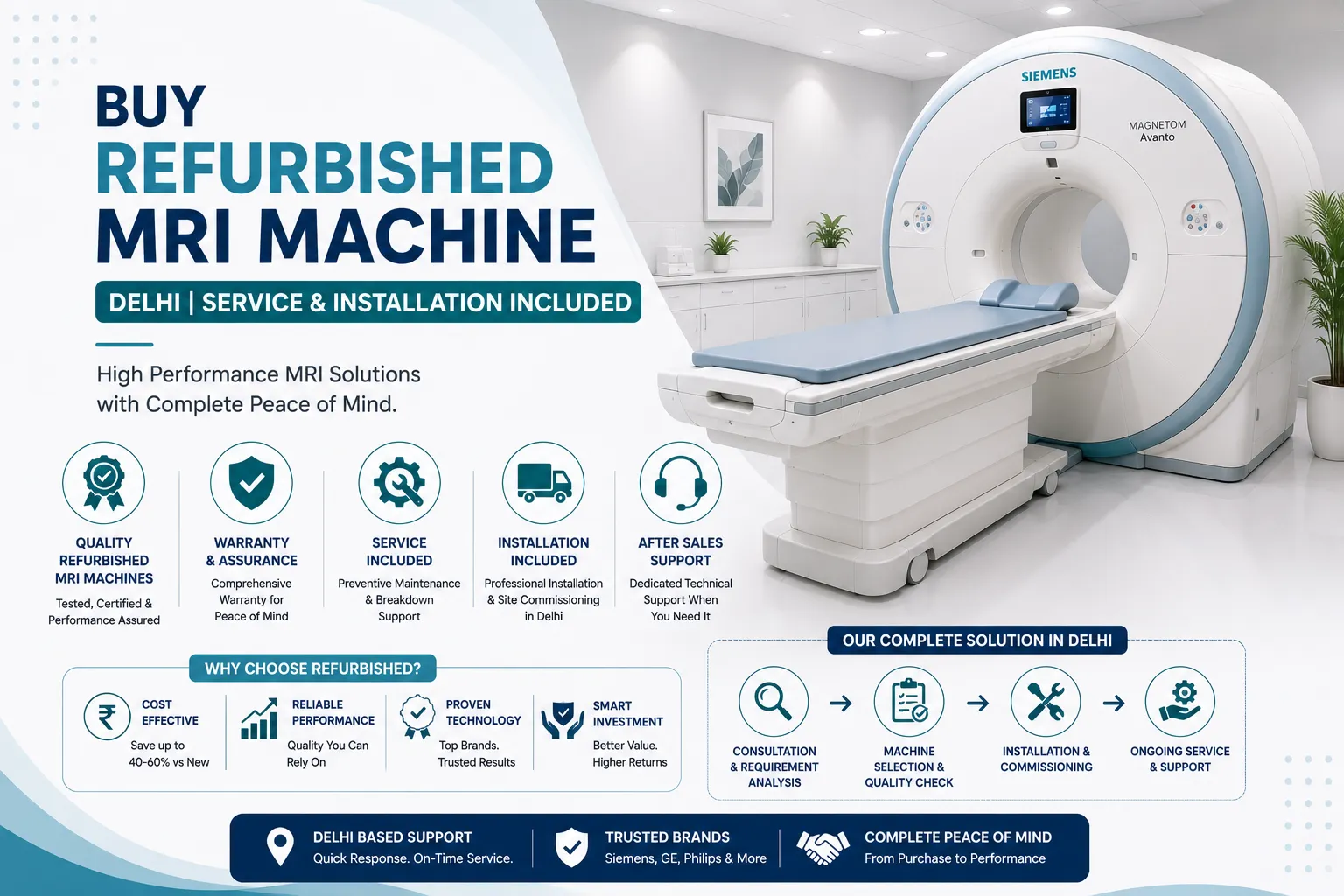
Refurbished does not mean second best, and it does not mean equal either. It means the quality of the process becomes the thing you are buying. A refurbished 1.5T system from a proven platform, properly inspected, tested and supported, can be a sound hospital workhorse. A poorly documented one is a risk at any price.
If Siemens platforms interest you, our Complete Buyer's Guide to Refurbished Siemens MRI Machines walks through model families and the checks that matter. If you prefer to research and compare suppliers remotely first, Buy MRI Machine Online in 2026 explains what can sensibly be done online and what should never be settled without an on-site visit.
The Building Has a Vote
Every experienced installer has a story about the scanner that arrived before anyone checked the corridor. Your building will constrain your choice, so involve it early.
- RF shielding. The scan room needs to keep external radio interference out.
- Magnetic fringe field. The magnet's field extends beyond the scanner, and that determines safe zoning around the room.
- Power and cooling. Ask about the electrical supply, stabilisation, backup and the cooling arrangement, especially through hot months.
- Floor loading and delivery path. A magnet is heavy and bulky. Measure doors, lifts, corridors and turns from the road to the final room.
- Quench venting. Superconducting magnets need a safe route for helium to escape in the rare event of a quench.
- Safety zoning and screening. The American College of Radiology's four-zone approach is a widely used model for controlling access. Every person and object entering the room needs screening because the magnet is always on.
Your local team should also confirm which registrations and approvals apply to your particular hospital. Requirements depend on how the facility is licensed and what it offers, so treat that as a checklist item for your compliance staff.
A Scorecard You Can Copy
When two or three systems reach your final round, a simple scorecard keeps the discussion honest. Score each option from 1 to 5 against the criteria below, then adjust the importance of each criterion to suit your hospital. The weights are suggestions only.
| Criterion | Suggested weight | What to look for |
|---|---|---|
| Fit with case mix | High | Protocols and coils for your ten most common examinations |
| Site compatibility | High | Room, delivery route, power, shielding, cooling |
| Service and spare parts | High | Response commitments and parts availability in India |
| Workflow integration | Medium | PACS, RIS and DICOM connectivity |
| Patient comfort | Medium | Bore, noise, scan duration, positioning |
| Training and application support | Medium | Who trains your staff and for how long |
| Upgrade path | Lower | Software and hardware options as needs change |
The point is not the number itself. It is that a written comparison forces every stakeholder to say what they value before a favourite emerges.
From Decision to First Patient: The Stages
The journey looks similar for most hospitals, though the time each stage takes varies with the system and the site.
- Needs assessment. Case mix, patient profile, staff and budget boundaries.
- Site survey. Engineers assess the room, route, power and shielding.
- Shortlist and evaluation. Use your scorecard and request written technical details.
- Contract. Confirm scope, warranty, training and service terms in writing.
- Site preparation. Shielding, electrical work, cooling and any structural changes.
- Delivery and installation. Logistics, rigging and magnet placement.
- Commissioning and testing. Verification of performance before clinical use.
- Application training. Technologists and radiologists learn the system's protocols.
- Ongoing maintenance. Preventive visits and breakdown support under your chosen contract.
Hospitals tend to under-plan stages two and five, which is why delays cluster there.
Questions to Put to Every Supplier
Good suppliers welcome detailed questions. Ask each one:
- Can I see inspection, repair and testing records for this exact system?
- Which parts were replaced, and were they original manufacturer parts or equivalents?
- Which coils are included, and in what condition?
- What software version is loaded, and what options are enabled?
- Who performs installation and commissioning, and who trains our staff?
- What do your AMC and CMC options cover, and what do they exclude?
- How do you handle breakdowns, and how are spare parts sourced?
- Can I speak with an existing hospital customer who uses a comparable system?
An annual maintenance contract (AMC) and a comprehensive maintenance contract (CMC) are not interchangeable. A comprehensive plan usually includes spare parts along with labour, while a non-comprehensive plan tends to handle parts separately. Read the scope and the exclusions line by line, since coils and magnet components are common exceptions.
When comparing suppliers, our pages on the Refurbished MRI Machine Supplier in India and Refurbished MRI Machine Company in India explain what to expect from each type of provider. When you reach the budgeting stage, our MRI Machine Price in India page is the place to continue.
How Arnica Healthtech Can Support the Process
Arnica Healthtech is based in Palwal, Haryana, and works with refurbished Siemens MRI, Hitachi MRI and Hitachi CT systems for facilities across India. Its services span sales, installation, repair, upgrades, de-installation and relocation, and both annual and comprehensive maintenance contracts. The company also lists site planning, logistics and application training among the support it provides during installation.
For a hospital, that breadth matters because the moments when projects go wrong, such as site surveys, delivery and the first months of service, are exactly where continuity helps. Whichever supplier you choose, ask them to show you their process in the same detail as the questions above.
Bring Your Case Mix, Not Just a Budget
The most productive first conversation with any supplier begins with your ten most common examinations, your floor plan and your patient profile. If you would like to talk through a hospital project with Arnica Healthtech, call +91 95605 07877 or send an enquiry through the contact page. Clinical decisions about which examinations to perform remain with your radiologists and medical advisers.