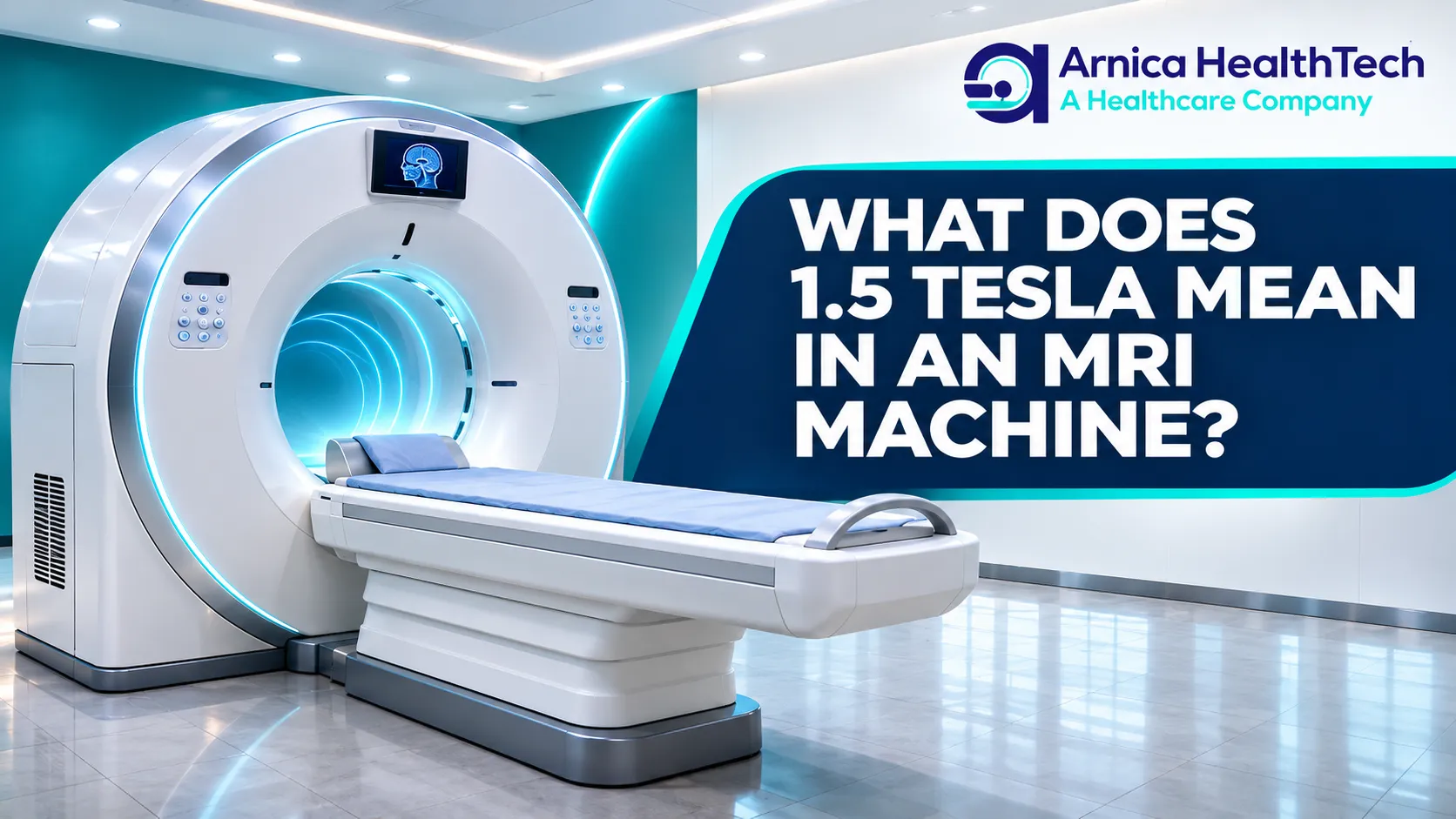
A typical fridge magnet has a strength of about 0.005 Tesla. The magnet inside most hospital MRI scanners in India is 1.5 Tesla, roughly 300 times stronger than that fridge magnet and about 30,000 times stronger than the Earth's own magnetic field. That single number on the spec sheet shapes image quality, scan time, running cost and price. This guide explains in plain language what 1.5 Tesla means in an MRI machine and why it matters.
Arnica Healthtech has spent more than 14 years supplying, installing and servicing refurbished MRI systems across India, so we see buyers wrestle with this question every week. Below we cover what the Tesla number measures, what 1.5 Tesla means for patients and doctors, how it compares with 3T and open MRI, and how to decide whether a 1.5T scanner is right for your centre.
What Is a Tesla?
The Tesla (T) is the international unit of magnetic field strength. It is named after the inventor Nikola Tesla. One Tesla equals 10,000 Gauss, an older unit that is still used for small magnets and for safety zones around MRI rooms.
Some everyday comparisons help put the number in context:
| Magnetic source | Approximate strength |
|---|---|
| Earth's magnetic field | About 0.00005 T (50 microtesla) |
| Fridge magnet | About 0.005 T |
| Open, low-field MRI | 0.2 T to 0.4 T |
| Standard clinical MRI | 1.5 T |
| High-field clinical MRI | 3 T |
| Ultra-high-field research MRI | 7 T |
So when a brochure says "1.5 Tesla MRI", it means the main magnet produces a steady field of 1.5 Tesla inside the scanner bore.
What Does 1.5 Tesla Mean in an MRI Machine?
In simple terms, 1.5 Tesla means the strength of the main magnet that the MRI uses to create images. This magnet is switched on all the time, even when no patient is being scanned. The higher the field strength, the more signal the scanner can collect from the body.
The MRI 1.5 Tesla meaning becomes clearer when you look at what the magnet actually does:
- It aligns hydrogen protons. The body is full of water, and each water molecule contains hydrogen. Inside a 1.5T field, a tiny excess of hydrogen protons line up with the magnet.
- It sets the radio frequency. At 1.5 Tesla, hydrogen protons spin (precess) at about 63.9 MHz. The scanner sends radio pulses at exactly this frequency to tip the protons out of alignment.
- It produces the signal. When the pulse stops, the protons relax back and release a faint radio signal. Coils pick up this signal, and the computer turns it into an image.
Because different tissues relax at different speeds, the scanner can show contrast between fat, water, muscle, brain matter and disease. A stronger magnet aligns more protons, which produces more signal. That is why field strength is the first number most people look at.
How the 1.5T magnet is built
Most 1.5T scanners use a superconducting magnet. Coils of niobium-titanium wire are cooled with liquid helium to around minus 269°C, where they lose all electrical resistance. Once current is started in the coils, it keeps flowing without a power supply, which is why the magnetic field stays on day and night.
Modern systems use a cold head and helium compressor to keep the helium from boiling away. Many newer 1.5T magnets are described as zero helium boil-off, which reduces the need for refills.
What 1.5 Tesla Means for Image Quality
Field strength mainly affects the signal-to-noise ratio (SNR). More signal means clearer images or faster scans. A 1.5T scanner offers enough signal for high-quality imaging of almost every part of the body, which is why it became the global workhorse of clinical MRI.
What 1.5 Tesla MRI means for daily practice:
- Clear, reliable images of the brain, spine, joints, abdomen and pelvis
- Well-established protocols that radiologists trust and know how to read
- Fewer artefacts than 3T in some areas, such as near metal implants and in the abdomen
- Good performance for cardiac MRI, angiography and whole-body screening
- Strong compatibility with implants, because many devices are tested and labelled for 1.5T
Where 1.5T has limits
For some very detailed studies, such as advanced neuro imaging, functional MRI, spectroscopy and small-joint imaging at very high resolution, a 3T scanner offers more signal. Those studies are a small share of typical referrals in most Indian centres, but they matter for tertiary hospitals and research departments.
1.5 Tesla vs 3 Tesla vs Open MRI
| Feature | Open MRI (0.2T to 0.4T) | 1.5T MRI | 3T MRI |
|---|---|---|---|
| Signal and image detail | Lower | High | About twice 1.5T |
| Scan speed | Slower | Fast | Faster for many studies |
| Patient comfort | Very open, good for claustrophobia | Closed or wide bore | Closed or wide bore, louder |
| Implant compatibility | Good | Best documented | More restrictions |
| Helium | Not needed (permanent magnet) | Needed | Needed |
| Typical use | Orthopaedics, spine, small centres | Most clinical work | Advanced neuro, cardiac, research |
| Cost | Lowest | Moderate | Highest |
For a detailed comparison of the two main closed-bore options, read our guide on the 1.5T vs 3T MRI difference. To understand open and closed designs, see our article on types of MRI machines.
How 1.5 Tesla Affects the Physics of a Scan
Field strength changes more than signal. It shifts several physical effects that radiologists and technologists manage every day. Knowing these helps explain why a 1.5T scanner behaves differently from a 3T system with the same coils.
Larmor frequency and RF energy
The frequency at which hydrogen protons resonate rises in step with the field. At 1.5T it is about 64 MHz, while at 3T it is about 128 MHz. Higher frequencies deposit more radio energy in the body, measured as the specific absorption rate (SAR). Because SAR at 1.5T is roughly a quarter of what it would be at 3T for the same sequence, technologists can run demanding sequences with fewer safety limits.
T1 relaxation times
Tissue T1 times get longer as field strength increases. At 1.5T, T1 contrast between grey matter and white matter is crisp, and contrast-enhanced studies look familiar to radiologists who trained on these systems. This is one reason many reporting templates in India are still built around 1.5T images.
Chemical shift and susceptibility
Fat and water resonate at slightly different frequencies. The gap is about 220 Hz at 1.5T and about 440 Hz at 3T. Smaller gaps mean less chemical shift artefact at tissue boundaries. Susceptibility effects near air, bone and metal are also milder at 1.5T, which helps in sinus, abdominal and post-surgical imaging.
B1 field uniformity
At higher fields, the radio wavelength inside the body becomes shorter and can cause uneven brightness, especially in the abdomen and pelvis of larger patients. At 1.5T this effect is small, so body images tend to look more even without extra correction tools.
Why 1.5 Tesla Is the Most Common MRI Strength
When people ask what 1.5 Tesla means in practice, the honest answer is "the standard". Several reasons explain why 1.5T remains the most widely installed field strength in India and worldwide.
Balanced image quality
1.5T delivers enough signal for nearly every routine study without the stronger artefacts and heating effects that can appear at 3T. Radiologists get consistent, diagnostic images across the whole body.
Lower cost
A 1.5T scanner costs far less than a 3T system, both to buy and to run. Power, cooling and service costs are also lower, which makes a big difference to the monthly budget of a diagnostic centre.
Easier siting
Many 1.5T magnets are shorter and lighter than 3T magnets. That makes them easier to fit into existing hospital buildings, especially in tier 2 and tier 3 cities where space is limited.
Patient safety and implants
A large number of pacemakers, neurostimulators and orthopaedic implants are labelled as MR-conditional at 1.5T. Some of those same devices have tighter limits or no approval at 3T. For a general hospital that sees a wide mix of patients, that flexibility is important.
Proven platforms
Popular 1.5T systems such as the Siemens Avanto and Essenza have been used for many years, so engineers, spare parts and trained technologists are easy to find.
What 1.5 Tesla Means for Patients
For patients, the 1.5 Tesla number is mostly reassuring. It means:
- A well-proven, safe field strength used in millions of scans every year
- Typical exam times of about 15 to 45 minutes, depending on the body part
- Broad implant compatibility, after proper safety screening
- No ionising radiation, unlike CT or X-ray
The magnet is always on, so every patient is screened for metal objects, implants and devices before entering the scan room. Loud knocking sounds during the scan come from the gradient coils switching rapidly, not from the main magnet.
What 1.5 Tesla Means for Hospital Buyers
If you are planning to buy an MRI, the 1.5 Tesla means a balance of cost, capability and reliability. It suits:
- New diagnostic centres starting MRI services
- Multispeciality hospitals handling routine neuro, spine, joint and body referrals
- Orthopaedic and trauma centres
- Hospitals in smaller cities where patient volume and budgets favour a cost-effective scanner
A 3T system makes more sense for advanced neuro, cardiac and research programmes. An open MRI suits small orthopaedic practices and claustrophobic patients.
1.5 Tesla MRI machine price
Price is often the deciding factor. Refurbished 1.5T systems typically cost far less than new ones, while offering the same established platforms. You can see current ranges on our 1.5 Tesla MRI machine price page, and our guide on how much an MRI machine costs in India covers the full project budget, including site work.
What to check before buying a 1.5T MRI
- Manufacturing year and software version
- Helium level, cold head hours and magnet history
- Number of RF channels and the coil package included
- Bore size, especially if you see many larger or anxious patients
- Site requirements: room size, floor loading, RF cage and power
- Service response, spare parts availability and AMC terms
Common Myths About 1.5 Tesla MRI
Buyers and patients often hear claims about field strength that do not hold up in practice. Here are the ones we hear most often.
"A 1.5T MRI is outdated"
Manufacturers still launch new 1.5T platforms every few years, with modern gradients, digital coils and AI-based reconstruction. Faster software has narrowed the gap with 3T for many routine studies, so a well-specified 1.5T system remains a current, competitive choice.
"Higher Tesla always means better diagnosis"
A higher field gives more signal, but diagnosis depends on coils, sequences, technologist skill and the radiologist reading the scan. For spine, knee, shoulder and abdominal work, a good 1.5T exam is fully diagnostic. In some cases, such as patients with metal implants, 1.5T can even give the better result.
"1.5 Tesla is unsafe because the magnet is strong"
The field is strong, but the risks are well understood and controlled. Screening, MR-safe equipment and clear zoning around the scan room keep both patients and staff safe. The main danger is loose ferromagnetic objects, which is why strict entry rules exist in every MRI suite.
"Refurbished 1.5T machines give poor images"
A properly refurbished system is tested against the manufacturer's image quality specifications before handover. Image quality depends on magnet homogeneity, coil condition and software calibration, all of which a qualified engineer checks and documents.
Site Planning for a 1.5 Tesla MRI
The meaning of 1.5 Tesla also shows up in your building plan. A typical 1.5T installation needs:
- A scan room of roughly 30 to 40 square metres, plus separate equipment and control rooms
- An RF-shielded cage to block outside radio signals
- Magnetic shielding or adequate distance so the 5 Gauss line stays inside controlled areas
- A floor that can carry a magnet weighing about 4 to 6 tonnes
- Stable three-phase power, a chiller for the cold head and gradient cooling
- A quench pipe that vents helium safely outside the building
Our engineers survey the site, prepare layout drawings and coordinate the civil, electrical and RF shielding work so the scanner can be installed and handed over without delay.
Refurbished 1.5 Tesla MRI from Arnica Healthtech
We supply tested and calibrated 1.5T systems with full installation support. Explore our range of refurbished MRI machines, including:
- Siemens MAGNETOM Essenza 1.5T, a compact system with low running costs
- Siemens MAGNETOM Avanto 1.5T, a widely installed workhorse
- Siemens MAGNETOM Sempra 1.5T, with a 70 cm bore
If you need more capability, our refurbished Siemens MRI range also includes 3T systems such as the Spectra 3T, Verio 3T and Skyra 3T. For smaller centres, our refurbished Hitachi MRI range offers open systems like the Aperto Lucent and AIRIS Vento.
Other Equipment and Services
- Refurbished Siemens CT and refurbished Hitachi CT scanners
- Refurbished Siemens PET CT for oncology
- Refurbished Philips cath lab systems
- Linear accelerators for radiotherapy
- Installation, AMC, repairs and spare parts across India
For more background, read our earlier article on 1.5 Tesla MRI and the future of medical imaging, or learn how an MRI machine works.
Talk to Our MRI Experts
Not sure whether 1.5T, 3T or open MRI fits your centre? Share your patient volume, clinical focus and budget, and our team will recommend the right system with an itemised quote within 24 hours.
Call:+91 95605 07877
Email:support@arnicahealthtech.com
Get a Quote