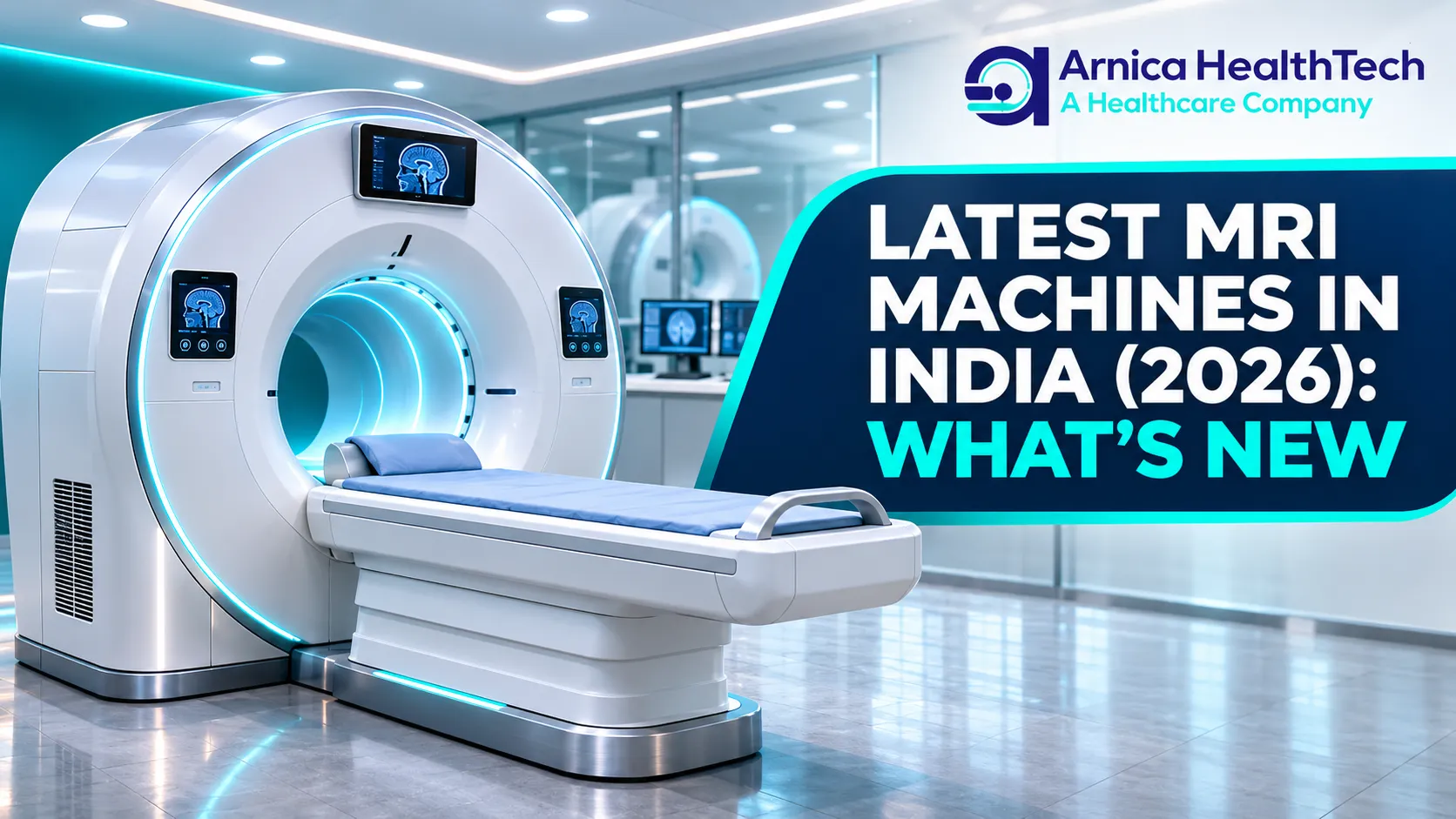
In 2026, a handful of 1.5T MRI scanners in India were running on less than one litre of liquid helium. A conventional magnet of the same strength needs over a thousand litres. That single change, along with AI-based image reconstruction and the first Made-in-India MRI systems, defines the latest MRI machines arriving in Indian hospitals this year.
For hospital owners and radiologists, the question is no longer only "1.5T or 3T". It is whether the newest technology fits your patient load, building and budget, or whether a proven refurbished system gives better value. This guide covers what is new in 2026, what each innovation means in practice, and how to decide.
Arnica Healthtech has supplied, installed and serviced MRI and CT systems across India for over 14 years. We track every launch because our customers ask us the same thing every week: is the latest MRI machine worth the price?
What Makes an MRI Machine "Latest" in 2026?
A latest MRI machine is not defined by field strength alone. Most new launches are still 1.5T or 3T. What has changed is how the magnet is cooled, how images are reconstructed, where the scanner is made, and where it can be installed.
Five trends stand out this year:
- Helium-free or sealed magnets that never need a refill
- Deep learning reconstruction that cuts scan times sharply
- Made-in-India and fully indigenous MRI scanners
- New form factors such as portable bedside MRI and open standing MRI
- Automated, push-button workflows that reduce dependence on highly experienced technologists
Each of these is covered below, with the systems that represent it.
Helium-Free MRI: The Biggest Change in Latest MRI Machines
Traditional superconducting magnets sit in a bath of liquid helium at about minus 269°C. Helium is expensive, its supply is unstable, and older magnets need a quench pipe that vents gas outside the building. Sealed magnets solve all three problems.
Siemens MAGNETOM Flow
Siemens Healthineers' MAGNETOM Flow is a 1.5T platform built on DryCool technology. It uses about 0.7 litres of liquid helium in a sealed circuit instead of up to 1,500 litres, has no quench pipe and needs a compact footprint. It comes in 60 cm and 70 cm bore versions. In India, Aarthi Scans and Labs installed the first helium-free 1.5T MAGNETOM Flow Plus in Bengaluru in 2025 and announced a further investment of over ₹100 crore in these scanners.
Philips BlueSeal and BlueSeal Horizon
Philips has sold sealed 1.5T BlueSeal magnets since 2018, with more than 2,000 installed worldwide. At RSNA 2025 it unveiled BlueSeal Horizon, the first 3.0T platform with a helium-free magnet, with commercial availability planned for select markets in 2026.
GE HealthCare SIGNA Sprint with Freelium
GE HealthCare's sealed-magnet approach, branded Freelium, reached the 1.5T SIGNA Sprint at RSNA 2025. Like its rivals, it removes the need for refills and simplifies siting.
What helium-free means for your centre
- No helium refills or boil-off costs over the life of the magnet
- No quench pipe, so the scanner can go on upper floors or in tight spaces
- Faster, cheaper installation and fewer civil works
- Lower power use in standby, which matters with India's electricity tariffs
The trade-off is price. These are premium new systems, and service for a sealed magnet depends heavily on the manufacturer.
Made-in-India MRI Machines
For years, almost every MRI in India was imported, either new or refurbished. 2026 is the year that started to change.
Wipro GE SIGNA Prime Elite
Wipro GE Healthcare launched SIGNA Prime Elite at IRIA 2026 in Hyderabad. It is manufactured at the company's PLI facility in India and includes AI tools such as AIR Recon DL for sharper images and AIR x for automated slice planning.
Indigenous 1.5T MRI from SAMEER and AIIMS
A 1.5T MRI developed under the Ministry of Electronics and IT by SAMEER is being installed at AIIMS Delhi for clinical trials. Its developers expect it to cut MRI equipment costs by 40 to 50 percent once it is in production.
VoxelGrids helium-free 1.5T
Bengaluru-based VoxelGrids, backed by Zoho, has deployed a fully indigenous 1.5T scanner with a helium-free design at a cancer care centre near Nagpur. The company says its design reduces costs by around 40 percent.
Time Medical MICA and QUIN
Time Medical India launched two helium-free 1.5T platforms, MICA and QUIN, at IRIA 2026, adding more choice in the mid-range segment.
Indigenous scanners are still new, with limited installed base and service history. They are worth watching, especially for government and tier 2 and 3 projects, but most private centres will want a few years of track record first.
AI Reconstruction and Faster Scans
The second big shift in the latest MRI machines is software. Deep learning reconstruction lets scanners collect less raw data and still produce sharp images.
All major brands now ship this technology. Siemens offers Deep Resolve, GE offers AIR Recon DL and Sonic DL, and Philips offers SmartSpeed Precise. In routine brain, spine and joint protocols, these tools can shorten scans significantly, which means more patients per day on the same magnet.
AI also automates positioning, coil selection and slice planning. Siemens' myExam Autopilot and GE's AIR x reduce variation between technologists, which helps centres that struggle to hire experienced MRI staff. For a deeper look, read our guide on AI in medical imaging for Indian diagnostic centres.
New Form Factors: Portable, Open and Standing MRI
Not every new MRI is a conventional tunnel.
- Portable bedside MRI. In May 2026, AIIMS Delhi introduced India's first routine use of a portable MRI for brain imaging in ICU and emergency patients. These low-field units roll to the bedside, so critically ill patients do not need to be moved.
- Open standing MRI. NM Medical in Mumbai launched an open standing MRI in September 2026, which images the spine and joints while the patient sits or stands under natural weight.
- Low-field 0.55T systems. Siemens' MAGNETOM Free.Max and Free.Star use a lower field with modern reconstruction, a wide 80 cm bore on Free.Max and very little helium.
These systems serve specific clinical needs. A general diagnostic centre will still rely on a 1.5T or 3T closed or wide-bore scanner for most work. To compare designs, see our guide on types of MRI machines.
Latest MRI Machines in India 2026 at a Glance
| System | Field strength | What is new | Best suited to |
|---|---|---|---|
| Siemens MAGNETOM Flow | 1.5T | 0.7 L helium, no quench pipe, AI workflow | High-volume chains, space-limited sites |
| Philips BlueSeal 1.5T | 1.5T | Sealed magnet, proven since 2018 | Hospitals wanting low helium risk |
| Philips BlueSeal Horizon | 3T | First helium-free 3T magnet | Premium neuro and research centres |
| GE SIGNA Sprint (Freelium) | 1.5T | Sealed low-helium magnet | Multi-site operators |
| Wipro GE SIGNA Prime Elite | 1.5T | Made in India, AI reconstruction | Mid-size hospitals and centres |
| Indigenous 1.5T (SAMEER, VoxelGrids) | 1.5T | Domestic design, lower cost target | Government and pilot installations |
| Siemens Free.Max | 0.55T | 80 cm bore, very low helium | Claustrophobic and larger patients |
| Portable MRI | Low field | Bedside imaging | ICUs and emergency departments |
Latest MRI Machine Price: What to Expect
New launches sit at the top of the market. A new 3T scanner in India typically costs ₹10 to ₹20 crore, and new 1.5T systems with the latest helium-free magnets and AI packages also run into many crores before site work. Manufacturers rarely publish list prices, and final quotes depend on coils, software and service terms.
That gap is why many Indian centres still choose refurbished systems. A refurbished 1.5T MRI typically costs ₹1.5 to ₹3.5 crore and a refurbished 3T about ₹3 to ₹5.5 crore. See current ranges on our MRI machine price in India page, and compare both routes in our guide to new vs refurbished MRI price in 2026.
Specific pages for 1.5 Tesla MRI machine price and 3 Tesla MRI machine price break the numbers down further.
Should You Buy the Latest MRI Machine or a Refurbished One?
The newest scanner is not automatically the right one. The answer depends on volume, case mix, building and cash flow.
When the latest MRI makes sense
- You run a large chain with high daily scan volumes
- Your building cannot take a quench pipe or a heavy magnet
- You need advanced neuro, cardiac or research protocols
- You can fund the higher capital cost without stretching your loan
When a refurbished MRI is the smarter buy
- You are opening a new centre and need faster payback
- Your work is mostly routine brain, spine, joint and abdomen scans
- You are in a tier 2 or tier 3 city where scan rates are lower
- You want proven platforms with easily available spare parts and engineers
Our refurbished MRI machines are tested and calibrated, installed with full site support, and backed by AMC. Many come with software upgrades that bring modern sequences to proven magnets. Our guide on how to choose the best MRI machine for hospitals in India walks through the full decision.
Other MRI Trends to Watch in 2026
Beyond the headline launches, several quieter improvements now appear across the latest MRI machines from every major brand.
Wider bores and quieter scans
Seventy centimetre bores have become standard in new mid-range and premium systems. They make scanning easier for larger, anxious and claustrophobic patients, which lowers repeat and cancelled scans. Noise reduction sequences also cut the familiar knocking sound, so more patients complete their exam without sedation.
Energy-saving modes
Newer systems switch to low-power modes overnight and between patients. Siemens reports 30 to 40 percent annual energy savings for MAGNETOM Flow compared with previous generations. With commercial power tariffs rising across Indian states, this matters for monthly running costs.
Better implant compatibility
Many new scanners include dedicated protocols for patients with MR-conditional pacemakers and orthopaedic implants. This lets centres accept referrals that older workflows would have turned away.
Ultra-high-field research systems
At the top end, 7T MRI is moving from pure research into selected clinical use worldwide, mainly for advanced neuro imaging. In India it remains limited to a few research institutions and is not a practical option for diagnostic centres.
How Latest MRI Technology Reaches Refurbished Systems
New hardware such as sealed magnets cannot be added to an older scanner. Much of the progress in the latest MRI machines, however, is software, and some of it reaches proven platforms through upgrades.
When we refurbish a Siemens system, we look at the software line it can run. Later software versions on platforms such as the Avanto, Essenza, Aera, Skyra and Spectra bring improved sequences, better parallel imaging and faster protocols compared with the original release. Coil upgrades, such as higher channel head and spine coils, also lift image quality noticeably.
This is why the gap between a well-specified refurbished 1.5T and a brand-new one is smaller in day-to-day reporting than the price difference suggests. For routine neuro, spine and musculoskeletal work, a refurbished scanner with current software and good coils produces images that radiologists report with confidence.
The areas where new systems clearly lead are helium savings, siting flexibility, energy use and the newest AI reconstruction. Weigh those against your volume and budget rather than buying on launch headlines alone.
What to Check Before Buying Any Latest MRI Machine
- Local service network and engineer response time in your city
- Spare parts availability, especially for new sealed magnets
- Coil package, channel count and software options included in the quote
- Upgrade path, since some platforms can be upgraded in bore or features later
- Power, cooling and site needs, even for helium-free systems
- AERB, CDSCO and other regulatory approvals for the exact model
- Training for technologists and radiologists
Factor in the full project cost, including building work and staffing. Our breakdown of the cost of setting up a diagnostic centre in India helps with that budget.
MRI Machines Available from Arnica Healthtech
We supply refurbished MRI systems from Siemens and Hitachi, matched to your clinical needs and budget.
- Refurbished Siemens MRI: MAGNETOM Essenza 1.5T, Avanto 1.5T, Sempra 1.5T, Spectra 3T, Verio 3T and Skyra 3T
- Refurbished Hitachi MRI: open systems such as the Aperto Lucent and AIRIS Vento
Other Imaging Equipment and Services
- Refurbished Siemens CT and refurbished Hitachi CT scanners
- Refurbished Siemens PET CT for oncology and nuclear medicine
- Refurbished Philips cath lab systems for cardiology
- Linear accelerators for radiotherapy
- Installation, site planning, AMC, repairs and spare parts across India
New to MRI technology? Start with our explainers on how an MRI machine works and the difference between 1.5T and 3T MRI.
Get Expert Advice on Your Next MRI
The latest MRI machines bring real gains in helium savings, speed and siting. For many Indian centres, though, a well-refurbished 1.5T or 3T system still delivers the best return. Share your patient volume, clinical focus and budget, and our team will recommend the right option with an itemised quote within 24 hours.
Call:+91 95605 07877
Email:support@arnicahealthtech.com
Get a Quote