India has more than 500 PET-CT scanners, yet that works out to only about 0.3 scanners per million people, far below the WHO benchmark of 2. For cancer patients, that gap often means long waits and long journeys for a single scan. For hospitals, it signals strong and growing demand. This guide explains what a PET CT scan machine is, how it works step by step, what it is used for, and what it costs to buy and run one in India.
Arnica Healthtech has spent more than 14 years supplying, installing and servicing high-end imaging equipment across India, including refurbished Siemens PET-CT systems. We have written this guide for hospital owners, radiologists, oncologists and anyone who wants a clear picture of how a PET CT machine fits into modern cancer care.
What Is a PET CT Scan Machine?
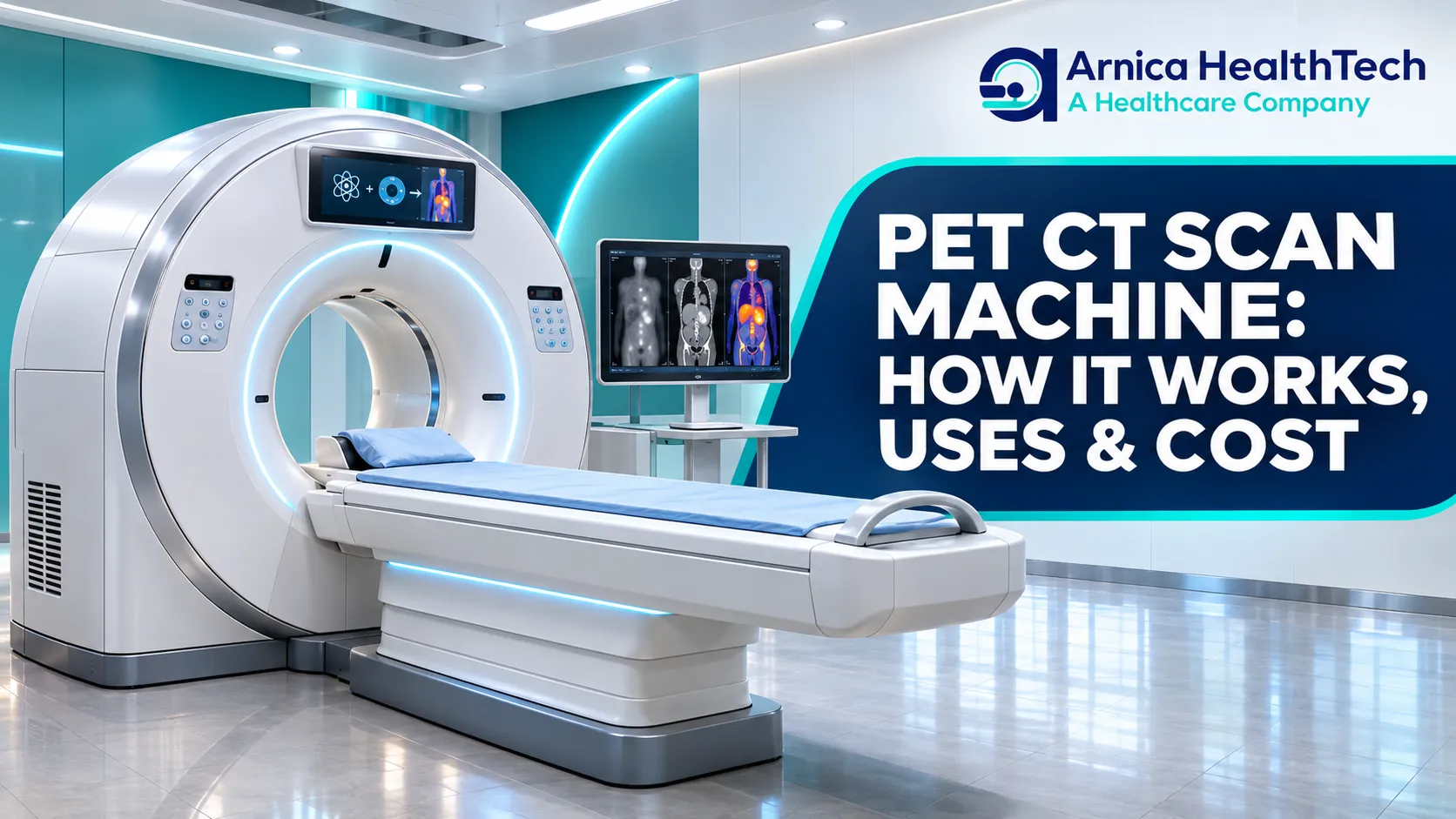
A PET CT scan machine combines two imaging systems in one gantry:
- PET (positron emission tomography) shows how tissues are functioning by tracking a small amount of radioactive tracer in the body.
- CT (computed tomography) shows detailed anatomy using X-rays.
When the two image sets are fused, doctors can see both where an abnormality is and how active it is. A tumour that looks like a small shadow on CT may light up brightly on PET, which tells the doctor it is metabolically active.
The combined system has largely replaced standalone PET. Fused PET-CT images help resolve many diagnostic dilemmas caused by normal physiological uptake on PET alone, which is why stand-alone PET scanners are no longer manufactured. Today, when patients and doctors say "PET scan machine", they almost always mean a PET CT machine.
PET CT vs CT vs MRI
| Feature | PET CT scan | CT scan | MRI |
|---|---|---|---|
| What it shows | Metabolic activity plus anatomy | Anatomy and structure | Soft tissue detail and function |
| Main use | Cancer staging, treatment response, cardiac and neuro function | Trauma, chest, abdomen, bones | Brain, spine, joints, soft tissue |
| Radiation | Yes, from tracer and CT | Yes, from X-rays | No ionising radiation |
| Typical scan time | About 20 to 30 minutes on the table, after an uptake period | A few minutes | 15 to 45 minutes |
How Does a PET CT Scan Machine Work?
A PET CT scan machine works by tracking a radioactive tracer that collects in active tissues, then overlaying that information on a CT image. The most common tracer is F-18 FDG, a form of glucose.
Step 1: The tracer is produced
FDG is made in a cyclotron, a particle accelerator that creates short-lived radioactive isotopes. Its half-life is about 110 minutes, so it must be produced nearby and delivered quickly. Most PET-CT centres in India buy FDG from a commercial cyclotron rather than running their own.
Step 2: The patient is prepared and injected
Patients usually fast for at least four hours before an FDG scan and avoid strenuous exercise beforehand, because both affect how glucose is used in the body. Blood sugar is checked, and the tracer is injected into a vein.
Step 3: The uptake period
The patient rests quietly while the tracer spreads through the body. FDG scans are typically carried out about 60 minutes after injection. Cancer cells use more glucose than most normal cells, so they absorb more FDG during this time.
Step 4: The CT scan
The patient lies on the table and moves into the gantry. For PET-CT, the whole-body CT scan is usually done first. The CT provides anatomical detail and is also used to correct the PET data for attenuation, which is the absorption of signal by body tissue.
Step 5: The PET scan
As FDG decays, it releases positrons. Each positron meets an electron almost immediately, and the pair annihilate to produce two gamma rays travelling in opposite directions. A ring of detector crystals around the patient records these gamma rays. By detecting both rays at almost the same moment, the scanner can calculate where in the body the event happened.
Step 6: Image fusion and reporting
The computer reconstructs the PET data and fuses it with the CT images. A standardised uptake value (SUV) is calculated to measure how much tracer each area has absorbed. A nuclear medicine physician then reads the scan and prepares the report.
Main Components of a PET CT Machine
- PET detector ring: made of scintillation crystals such as LSO, LYSO or BGO, which convert gamma rays into light.
- Photodetectors: photomultiplier tubes or newer silicon photomultipliers (SiPM) that turn that light into electrical signals.
- CT gantry: an X-ray tube and detector array, from 16 to 128 slices or more.
- Patient table: moves the patient through both the CT and PET fields.
- Reconstruction computer and software: produces images, fusion, SUV measurements and reports.
Technologies that improve image quality
- Time-of-flight (TOF): measures the tiny difference in arrival time of the two gamma rays, which sharpens images and helps reduce dose or scan time.
- Extended field of view: covers more of the body in each bed position for faster scans.
- Digital detectors: SiPM-based systems offer higher sensitivity and resolution.
- Motion correction: reduces blurring from breathing.
What Is a PET CT Scan Used For?
Oncology
Cancer care is the main use of a PET CT scan machine. It helps doctors:
- Detect cancer and find the primary site in difficult cases
- Stage cancer by showing spread to lymph nodes and distant organs
- Check how well chemotherapy or radiotherapy is working
- Detect recurrence after treatment
- Plan radiotherapy by defining active tumour areas
It is widely used for lymphoma, lung, head and neck, breast, colorectal, oesophageal and cervical cancers, among others.
Cardiology
Cardiac PET-CT can assess blood flow to the heart muscle and whether damaged muscle is still viable. That helps cardiologists decide whether a patient will benefit from bypass surgery or stenting.
Neurology
PET-CT helps evaluate dementia, including Alzheimer's disease, by showing patterns of reduced brain metabolism. It can also help locate the seizure focus in some patients with epilepsy before surgery.
Infection and inflammation
FDG also collects in areas of active inflammation, so PET-CT can help find hidden infections or inflammatory conditions when other tests are inconclusive.
Tracers beyond FDG
Specialised tracers expand what PET-CT can do. PSMA tracers target prostate cancer, DOTA tracers target neuroendocrine tumours and F-DOPA is used in certain brain and neuroendocrine conditions. These scans typically cost more than standard FDG studies.
Is a PET CT Scan Safe?
A PET CT scan involves a small dose of radiation from the tracer and from the CT. For most patients with cancer or another serious condition, the benefit of an accurate diagnosis far outweighs this risk. The tracer leaves the body quickly, mainly through urine, and drinking water after the scan helps clear it faster.
Some precautions apply:
- Pregnant or breastfeeding patients must tell the team before the scan.
- Diabetic patients need special preparation, because high blood sugar affects FDG uptake.
- Patients are usually advised to limit close contact with young children and pregnant women for a few hours after the scan.
For centres, radiation safety also covers staff. Shielded dispensing, careful handling in the hot lab and well-designed uptake rooms keep doses for technologists and nurses low.
How patients prepare for a PET CT scan
- Fast for about four to six hours before the scan, drinking only plain water
- Avoid heavy exercise for a day before the scan
- Share a full list of medicines, especially diabetes medicines and insulin
- Wear comfortable clothes without metal and remove jewellery
- Plan for a visit of two to three hours, including the uptake period
Clear preparation instructions matter to the hospital as well as the patient. A well-prepared patient gives better images and keeps the PET scan machine schedule running on time, which directly affects how many scans a centre can complete in a day.
PET CT Scan Cost for Patients in India
Patient charges vary by city, hospital, tracer and protocol. A few published examples give a useful picture:
- Yashoda Hospitals puts the average cost of a PET-CT scan in India at about ₹10,000 to ₹35,000.
- At HCG, a standard whole-body FDG PET-CT may cost about ₹24,500 to ₹65,500, while other PET protocols range from about ₹9,900 to ₹98,000.
- ManipalCigna gives an indicative average of about ₹20,000 for a PET scan.
For hospitals, these charges matter because they decide how quickly a PET CT machine pays for itself. A study at an Indian tertiary centre found an average of 30 PET-CT scans per day, with a unit cost of about ₹9,626 per scan once capital and operating costs were included.
PET CT Scan Machine Price in India
The purchase price of a PET CT scan machine depends on whether it is new or refurbished, the detector technology, time-of-flight capability and the CT slice count. In broad terms:
- Refurbished PET-CT systems usually cost a fraction of new systems, with older non-TOF units at the lower end and TOF systems such as the Siemens Biograph mCT higher up.
- New PET-CT systems cost significantly more, with digital scanners at the top of the range.
For a detailed price table by configuration, see our PET CT scan machine price guide. If you are also planning a standalone CT, our page on CT scan machine price in India covers current CT costs.
What else a PET-CT centre needs
- Shielded scanner room, uptake rooms and a hot lab for handling radioactive tracers
- Dose calibrator, radiation survey meters and radioactive waste storage
- AERB layout approval, licensing and a radiation safety officer
- A reliable FDG supply from a nearby cyclotron
- Trained nuclear medicine physicians and technologists
- Power backup, air conditioning and an annual maintenance contract
Why India Needs More PET CT Machines
India's PET-CT capacity has grown fast since the first installations in the mid-2000s, and most scanners and cyclotrons are now in the private sector. Even so, demand is well ahead of supply. Reports describe patients at some government hospitals in Lucknow waiting a month for a PET-CT appointment, and some at King George's Medical University waiting nearly two months.
For hospitals in tier 2 and tier 3 cities, adding a PET CT machine can keep oncology patients close to home, strengthen cancer programmes and build referral networks. A refurbished system makes that investment far more achievable.
Refurbished Siemens PET CT from Arnica Healthtech
Our refurbished Siemens PET CT range is built around the Siemens Biograph mCT platform, a widely used hybrid system for oncology, cardiology and radiotherapy planning.
- 78 cm wide bore for radiotherapy positioning and larger patients
- Up to 128-slice CT that can also run as a standalone diagnostic CT
- LSO detector crystals for high-resolution PET
- Time-of-flight imaging for better image quality
- Clinical packages for oncology, cardiology and radiotherapy planning
Every system is tested, refurbished and calibrated before installation, and our team supports site planning, commissioning, training and long-term AMC.
What to check before buying a PET CT machine
- PET detector performance test results and calibration records
- Time-of-flight capability and detector crystal type
- CT slice count, tube history and software version
- Availability of FDG supply near your site
- Site requirements, shielding design and AERB approvals
- Service response time, spare parts and AMC terms
Our article on the quality assurance process for refurbished medical scanners explains what proper testing should include.
Other Imaging and Therapy Equipment
PET-CT usually sits alongside CT, MRI and radiotherapy in a cancer centre. Arnica Healthtech supplies refurbished systems across the full pathway.
- Refurbished Siemens CT, including go.Now, go.Top and Definition AS
- Refurbished Hitachi CT, including Scenaria
- Refurbished Siemens MRI and refurbished Hitachi MRI
- Linear accelerators for radiotherapy, including VenusX
- Refurbished Philips cath lab systems
- Installation, AMC, repairs and spare parts across India
Planning radiotherapy too? Read our guide on what a LINAC machine is.
Get Expert Advice on a PET CT Scan Machine
Whether you are opening a new nuclear medicine department or replacing an older system, our team can help you choose the right PET-CT configuration and plan the full project. Share your expected patient volume and site details, and we will send an itemised quote within 24 hours.
Call:+91 95605 07877
Email:support@arnicahealthtech.com
Get a Quote