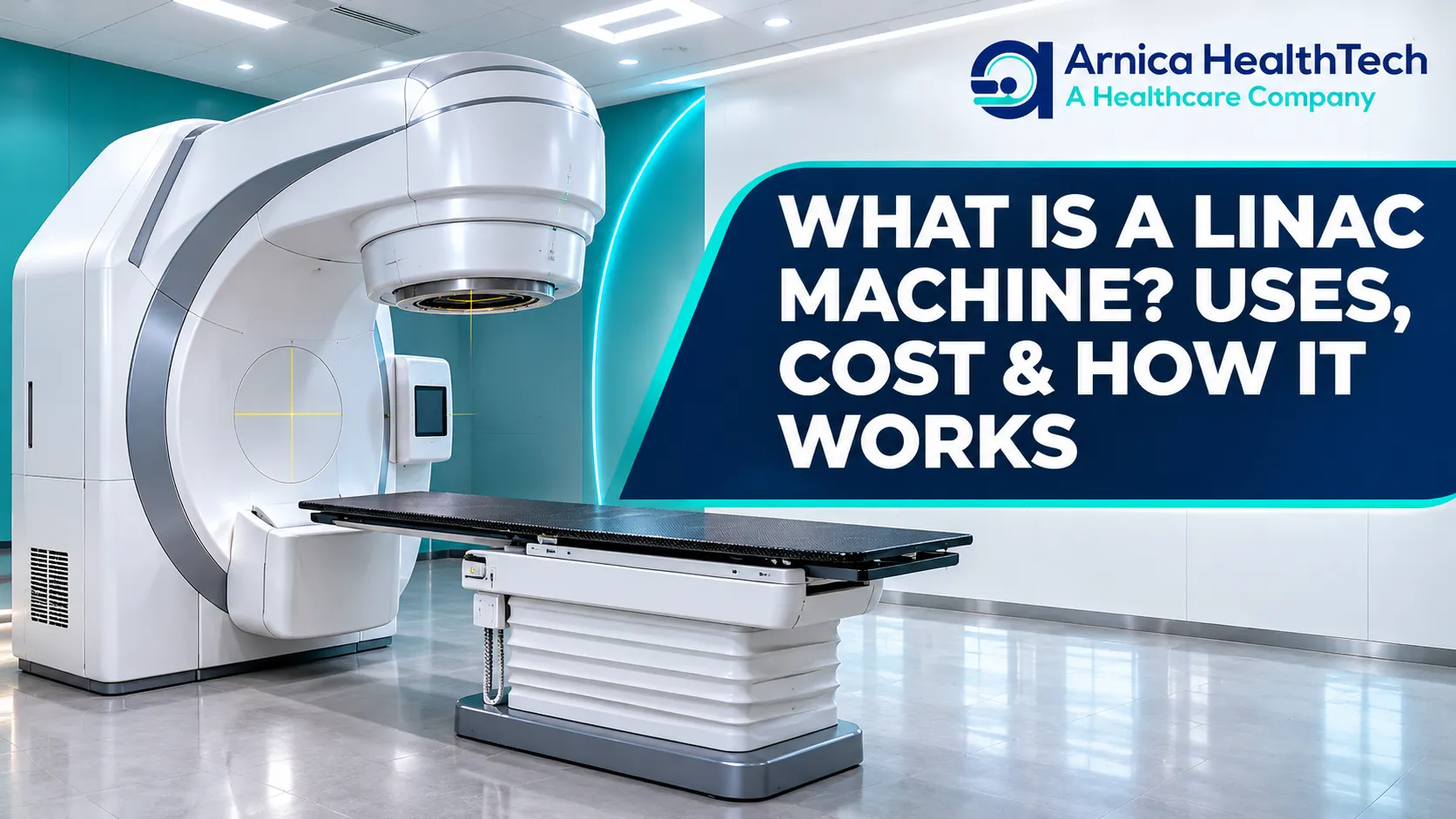
India has well under one radiotherapy machine for every million people, while the International Atomic Energy Agency recommends at least 1.5 and ideally four. Most of the machines that do exist are medical linear accelerators. If you are a hospital administrator, oncologist or investor trying to understand what is a LINAC machine, how it treats cancer and what it costs to set one up, this guide covers it in plain language.
Arnica Healthtech has spent more than 14 years supplying, installing and servicing high-end imaging and therapy equipment across India, including refurbished linear accelerators. Below we explain how a LINAC machine works, the cancers it treats, the main types and brands, the LINAC machine price in India, and what else a radiotherapy department needs before treating its first patient.
What Is a LINAC Machine?
A LINAC (medical linear accelerator) is a radiotherapy machine that produces high-energy X-rays or electrons and aims them precisely at a tumour. The radiation damages the DNA of cancer cells so they can no longer divide and grow. Healthy tissue around the tumour is spared as much as possible by shaping the beam and delivering it from many angles.
Unlike older cobalt-60 machines, a LINAC does not contain a radioactive source. It creates radiation electrically, only when the beam is switched on. That makes it safer to store, easier to regulate and far more flexible in the energies and techniques it can deliver. Over the past two decades, Indian cancer centres have steadily replaced telecobalt units with linear accelerators.
LINAC vs cobalt machine
| Feature | LINAC machine | Cobalt-60 machine |
|---|---|---|
| Radiation source | Generated electrically, only when switched on | Radioactive source, always emitting |
| Energy options | Multiple photon and electron energies | Single fixed energy |
| Advanced techniques | IMRT, VMAT, IGRT, SBRT, SRS | Mostly basic and 3D conformal treatment |
| Source replacement | Not needed | Source must be replaced every few years |
| Cost | Higher | Lower |
How Does a LINAC Machine Work?
A LINAC machine turns electrical energy into a precisely controlled radiation beam. The process happens in a few stages inside the gantry, the rotating arm that moves around the patient.
- Electron gun: produces a stream of electrons.
- Accelerating waveguide: microwaves from a magnetron or klystron push the electrons to nearly the speed of light.
- Bending magnet: turns the electron beam towards the patient.
- Target: for X-ray treatment, the electrons strike a metal target and produce high-energy photons. For superficial tumours, the electron beam is used directly.
- Collimators and MLC: jaws and a multi-leaf collimator (MLC) shape the beam to match the tumour outline.
- Gantry and couch: the gantry rotates 360° and a robotic couch positions the patient with millimetre accuracy.
Modern machines also carry imaging systems, such as kV X-ray and cone-beam CT (CBCT), so the team can check the tumour's position before and during treatment.
Key components of a LINAC
- Multi-leaf collimator, typically with 120 to 160 leaves on modern systems
- On-board imaging with kV, MV and cone-beam CT
- Six-degrees-of-freedom treatment couch for precise positioning
- Treatment planning system (TPS) to design the dose
- Oncology information system to manage schedules and records
- Dosimetry and quality assurance equipment
What Is a LINAC Machine Used For?
A LINAC machine treats a wide range of cancers, either on its own or alongside surgery and chemotherapy. In India, breast, head and neck, lung and cervical cancer together account for about 60% of radiotherapy needs.
- Head and neck cancers: common in India and often treated with IMRT to protect the salivary glands and spinal cord.
- Breast cancer: after surgery, to reduce the risk of recurrence.
- Cervical and other gynaecological cancers: usually combined with brachytherapy.
- Lung cancer: including SBRT for small early-stage tumours.
- Prostate cancer: with image guidance for high precision.
- Brain tumours and metastases: using stereotactic radiosurgery (SRS).
- Palliative treatment: to relieve pain from bone metastases and other symptoms.
Treatment techniques a LINAC can deliver
- 3D-CRT: three-dimensional conformal radiotherapy, the basic shaped-beam technique.
- IMRT: intensity-modulated radiotherapy, which varies beam intensity to sculpt the dose.
- VMAT: volumetric modulated arc therapy, which delivers IMRT while the gantry rotates, cutting treatment time.
- IGRT: image-guided radiotherapy, using daily imaging to correct the patient's position.
- SBRT and SRS: very high doses in a few sessions for small, well-defined targets.
The LINAC Treatment Process Step by Step
Understanding the patient journey helps hospitals plan staff, rooms and equipment. A typical course of LINAC treatment follows these stages.
- Consultation: the radiation oncologist reviews scans, pathology and history, and decides whether radiotherapy is needed.
- Simulation: the patient lies on a CT simulator in the exact treatment position. Masks or moulds keep them still, and small skin marks guide daily set-up.
- Planning: the oncologist outlines the tumour and nearby organs. A medical physicist then designs the beam arrangement in the treatment planning system to deliver the prescribed dose.
- Quality checks: the plan is measured on the LINAC before the first session to confirm the dose is delivered as designed.
- Treatment: the patient receives short daily sessions, usually five days a week. Each session takes about 10 to 20 minutes, and the radiation itself is painless.
- Follow-up: the team monitors side effects during treatment and reviews the response afterwards.
A standard course can run from a single session for radiosurgery to six or seven weeks for curative treatment of head and neck or cervical cancer. Faster techniques such as VMAT and SBRT shorten individual sessions or reduce the number of sessions, which increases how many patients one LINAC can treat each day.
What LINAC treatment costs patients in India
Patient charges help explain the revenue a LINAC can generate. Indicative ranges published by one Indian cancer hospital put IMRT at about ₹1.5 lakh to ₹3 lakh, IGRT at about ₹2 lakh to ₹3.5 lakh, and VMAT or advanced IMRT at about ₹2.5 lakh to ₹4.5 lakh per course. Actual charges vary by city, hospital and the number of sessions.
Types of LINAC Machines
Low-energy (single-energy) LINAC
These machines produce a single photon energy, usually 6 MV. They handle most common treatments, including head and neck, breast and palliative cases, and are often the first machine in a new centre.
High-energy (multi-energy) LINAC
These offer several photon energies, such as 6, 10 and 15 MV, plus electron beams. Higher energies help treat deep-seated tumours in the pelvis and abdomen, and electrons treat skin and superficial lesions.
Specialised systems
- Stereotactic platforms built for SRS and SBRT
- Ring-gantry systems designed for fast, image-guided workflows
- MR-LINAC systems that combine MRI with a linear accelerator for real-time tumour tracking
Major LINAC brands
The main manufacturers in India are Varian (TrueBeam, Halcyon, Clinac), Elekta (Versa HD, Infinity, Synergy) and Siemens, whose earlier ONCOR and ARTISTE platforms remain in use. Refurbished Siemens and Varian systems are common choices for hospitals starting radiotherapy on a tighter budget.
LINAC Machine Price in India
The LINAC machine price in India varies more than almost any other hospital equipment. A basic refurbished single-energy unit and a new high-end stereotactic system can differ by tens of crores. These are the indicative ranges based on public tenders, market listings and international pricing:
| LINAC category | Typical capability | Indicative price in India |
|---|---|---|
| Refurbished single-energy LINAC | 3D-CRT and IMRT, basic imaging | ₹3 crore to ₹6 crore |
| Refurbished multi-energy LINAC with VMAT and CBCT | IMRT, VMAT, IGRT | ₹5 crore to ₹12 crore |
| New mid-range LINAC | IMRT, VMAT, IGRT | ₹15 crore to ₹30 crore |
| New high-end LINAC | SRS, SBRT, advanced IGRT | ₹30 crore to ₹47 crore and above |
Prices are indicative and exclude bunker construction, GST and service contracts unless stated. Contact us for an itemised quote.
What real purchases show
- Madhya Pradesh bought LINAC machines for four medical colleges at about ₹46.7 crore each, including a four-year warranty, with four years of maintenance worth ₹4.4 crore.
- A LINAC for the new cancer hospital at MGM Medical College in Indore was valued at about ₹47 crore.
- AIIMS Bhopal has estimated its second LINAC at about ₹35 crore.
- Internationally, a turnkey used or reconditioned LINAC ranges from about $325,000 to more than $1.75 million, with an average of about $475,000 including shipping and installation.
Government tender prices usually include long warranties, planning systems and accessories, which is why they sit at the top of the range. A refurbished machine with a smaller scope can cost a fraction of that.
Factors that affect the LINAC machine price
- Energy configuration: single-energy vs multi-energy with electrons.
- Imaging: kV imaging and cone-beam CT add significant cost.
- MLC and delivery: finer leaves and VMAT capability cost more.
- Software: treatment planning system, oncology information system and stereotactic licences.
- Age and condition: for refurbished systems, the waveguide, magnetron or klystron and gantry electronics matter most.
- Warranty and service: multi-year comprehensive maintenance is a major part of total cost.
Beyond the Machine: Total Cost of a Radiotherapy Setup
A LINAC cannot operate without a shielded room and a trained team. Plan for these costs alongside the machine itself.
Radiation bunker
The LINAC must sit inside a bunker with thick concrete walls and a maze or shielded door. Bunker design depends on the machine's maximum energy and expected workload, and it must be approved by the Atomic Energy Regulatory Board (AERB). Construction often takes many months and can cost several crores. At AIIMS Bhopal, the combined cost of planned machines and their separate bunkers was estimated at ₹150 crore.
Supporting equipment
- CT simulator for treatment planning, often a dedicated wide-bore CT
- Treatment planning system and oncology information system
- Dosimetry and quality assurance tools, such as water phantoms and ion chambers
- Patient immobilisation devices like masks and vacuum cushions
- Brachytherapy unit for gynaecological and other cancers
If you are planning a CT simulator, our page on CT scan machine price in India gives current costs for different configurations.
Regulatory approvals
Every radiotherapy facility in India needs AERB approval for bunker layout, licensing for operation, and a qualified radiological safety officer. Planning these approvals early avoids long delays after the machine arrives.
Team
A radiotherapy department needs radiation oncologists, medical physicists, radiation therapy technologists and nursing staff. Their training and availability are often as important as the machine itself.
Why India Needs More LINAC Machines
India's radiotherapy gap is large. A 2024 analysis found 823 functioning radiotherapy machines across 554 facilities, with 69.4% of institutes having only one machine. The same study put India's teletherapy density at 0.6 machines per million people, with a shortfall of 1,209 machines.
The gap shows up in patient care too. An ICMR-linked study found that only 28.5% of Indian cancer patients receive radiotherapy, compared with an estimated optimal rate of 58.4%. For hospitals in tier 2 and tier 3 cities, adding a LINAC can mean patients no longer travel hundreds of kilometres for treatment.
Refurbished LINAC: A Practical Option
A refurbished LINAC can bring advanced radiotherapy to a hospital at a fraction of the price of a new system. Our refurbished LINAC machine range is built around Siemens platforms, with configurations that can include:
- Photon and electron beams with energies from 6 MeV up to 25 MeV
- Dose rates of up to 2400 MU/min
- 120 to 160 leaf multi-leaf collimators
- kV/MV imaging, cone-beam CT and 4D imaging
- IMRT, VMAT, SBRT, SRS and IGRT techniques
- Six-degrees-of-freedom patient couch
Every machine is inspected, refurbished and calibrated, and our team supports installation, commissioning and long-term maintenance. You can also explore the VenusX in our refurbished linear accelerator range.
What to check before buying a refurbished LINAC
- Manufacturing year, software version and remaining manufacturer support
- Condition of the waveguide, magnetron or klystron, and gantry electronics
- MLC performance and leaf calibration records
- Imaging capability and whether CBCT is included
- Compatibility with your treatment planning and oncology information systems
- Service, spare parts and physics support in your region
Other Equipment from Arnica Healthtech
Cancer care usually needs diagnostic imaging alongside radiotherapy. Arnica Healthtech supplies refurbished systems for the whole oncology pathway.
- Refurbished Siemens PET CT for cancer staging and treatment response
- Refurbished Siemens CT, including go.Now, go.Top and Definition AS, suitable as CT simulators
- Refurbished Hitachi CT, including Scenaria
- Refurbished Siemens MRI and refurbished Hitachi MRI
- Refurbished Philips cath lab systems
- Installation, AMC, repairs and spare parts across India
For more reading, see our guide on refurbished vs second hand medical equipment and our article on the quality assurance process for refurbished medical scanners.
Plan Your LINAC Project with Arnica Healthtech
Whether you are starting a new radiotherapy department or adding a second machine, our team can help you choose the right LINAC configuration and plan the full project. Get a quote with an itemised breakdown within 24 hours.
Call:+91 95605 07877
Email:support@arnicahealthtech.com