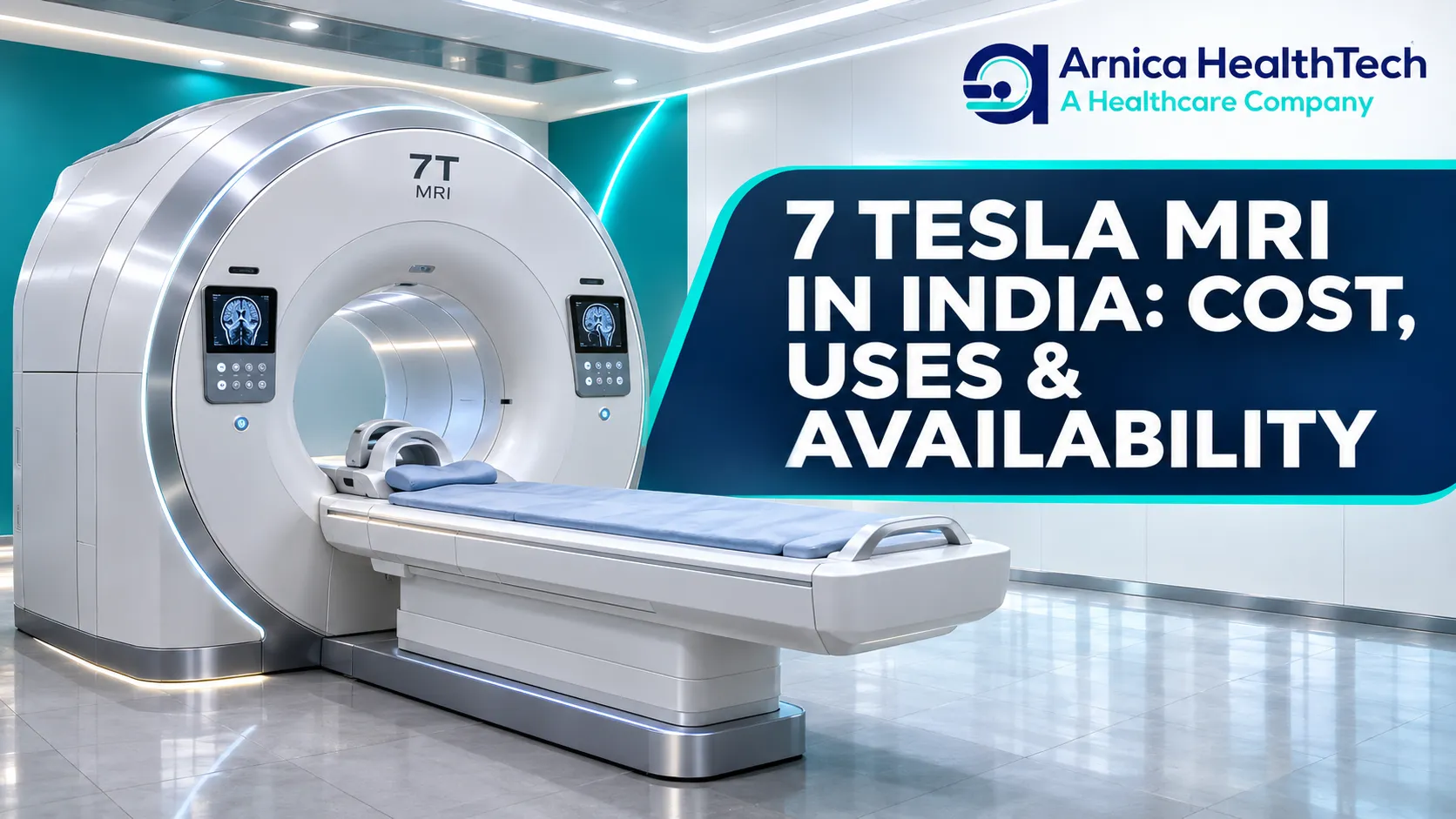
Most MRI scanners in Indian hospitals run at 1.5 Tesla, and the most advanced clinical departments use 3 Tesla. A 7 Tesla scanner sits in a different league altogether. It has more than twice the signal of a 3T system, it can show structures smaller than a millimetre, and a single installation abroad has cost as much as a small hospital. That gap is why interest in 7 Tesla MRI in India keeps growing among neurologists, researchers and large hospital groups.
This guide explains what a 7T MRI is, what it is actually used for, where it stands in India today, what a 7 Tesla MRI machine in India price looks like, and why most hospitals still get far better value from 1.5T and 3T systems. At Arnica Healthtech, we have spent more than 14 years supplying and servicing refurbished MRI, CT and PET-CT systems across India, so we look at the question from a buyer's point of view, not a brochure's.
What Is a 7 Tesla MRI?
The "Tesla" figure describes the strength of the MRI magnet. Clinical MRI scanners are usually 1.5T or 3T. A 7T scanner is called an ultra-high-field (UHF) system. Its magnet is roughly five times stronger than the 1.5T magnets used in most diagnostic centres.
A stronger field produces more MR signal. Siemens Healthineers states that 7T imaging offers double the signal-to-noise ratio (SNR) of 3T. Radiologists can use that extra signal in two ways: to see much finer detail, or to scan faster at the same detail.
How 7T compares with 1.5T and 3T
| Feature | 1.5T MRI | 3T MRI | 7T MRI |
|---|---|---|---|
| Typical use | Routine diagnostics in most centres | Advanced neuro, MSK, cardiac and body imaging | Specialist neuro and joint imaging, research |
| Relative signal | Baseline | About 2× 1.5T | More than 2× 3T |
| Body coverage | Whole body | Whole body | Clinical use mainly limited to head and extremities |
| Availability in India | Widely available | Common in large hospitals and chains | Extremely limited |
| Purchase cost | Lowest | Higher | Many times higher |
For a detailed look at the two common field strengths, read our guide on 1.5T vs 3T MRI.
From Research Tool to Clinical Scanner
For many years, 7T scanners were used only in research labs. That changed in October 2017, when the US Food and Drug Administration cleared the Siemens MAGNETOM Terra, the first 7T MRI cleared for diagnostic imaging. Before that clearance, clinical MRI systems in the US were limited to 3T and below.
The clearance came with clear limits. The FDA cleared the Terra for patients weighing more than 66 pounds (about 30 kg), and only for examinations of the head, arms and legs. Its first clinical coils were designed for neuro and knee imaging.
The 7T scanners on the market today
- Siemens MAGNETOM Terra: released in 2017 as the first clinical 7T, with up to 8 transmit and 64 receive channels, a 50% lighter actively shielded magnet and zero helium boil-off.
- Siemens MAGNETOM Terra.X: the second-generation system, cleared by the FDA in April 2024. It introduced the first eight-channel parallel transmit architecture for clinical use.
- GE HealthCare SIGNA 7.0T: cleared by the FDA in November 2020 for research and clinical use, with a 60 cm bore designed for neurodegenerative disease and extremity imaging.
Siemens Healthineers says more than 75% of the 7T scanners deployed worldwide are its systems. That matters for any future buyer, because service expertise, coils and research collaborations are concentrated around the dominant platform.
Clinical Uses of a 7 Tesla MRI
A 7T scanner is not a faster version of a routine MRI. Its value shows up in a narrow set of cases where 1.5T and 3T cannot see enough detail.
Epilepsy
Some patients with drug-resistant epilepsy have small cortical lesions that do not show up on 3T scans. Finding them can make a patient eligible for surgery. Ultra-high-field imaging can reveal these subtle abnormalities.
Multiple sclerosis
7T imaging can show fine features of MS lesions, including small cortical lesions and the central vein inside white matter lesions. These details can help separate MS from conditions that look similar on standard scans.
Neurodegenerative diseases
Alzheimer's disease, Parkinson's disease and other neurodegenerative conditions involve small brain structures such as the hippocampal subfields and the substantia nigra. 7T imaging can show these structures in much finer detail, which is why it is heavily used in dementia research.
Surgical planning
Neurosurgeons use detailed imaging to plan deep brain stimulation and tumour surgery. Siemens highlights sub-millimetre functional MRI precision for pre-surgical tumour assessment as one of the Terra's clinical uses.
Musculoskeletal imaging
The knee was one of the first FDA-cleared applications for 7T. High resolution helps show cartilage, ligaments and small tears in fine detail.
Metabolic imaging and spectroscopy
7T makes it practical to image nuclei other than hydrogen, such as sodium and phosphorus, and to run MR spectroscopy with better resolution. This adds a metabolic layer to anatomical imaging and is a major focus of research.
7 Tesla MRI in India: Current Availability
India has one of the fastest-growing MRI markets in the world, but ultra-high-field imaging has not yet reached routine clinical care. At the time of writing, we could not find any publicly reported clinical 7 Tesla MRI machine in India. India's most advanced clinical departments run 3T systems, and the country's MRI expansion has focused on making 1.5T scanners more affordable and accessible.
The wider MRI base in India is still small for a country of its size. One industry estimate puts the total installed base of MRI at about 4,800 units, roughly three times lower than CT, largely because of high capital costs and import dependency. In that context, a 7T scanner is a research investment rather than a mainstream clinical one.
Because this field changes quickly, a hospital planning ultra-high-field imaging should confirm the latest installations directly with manufacturers and leading research institutions before making any decision.
Why 7T has not spread in India
- Capital cost: a 7T system costs many times more than a 3T scanner.
- Limited clinical scope: clinical clearance covers mainly the head and extremities, not the whole body.
- Specialist staff: 7T needs physicists, research radiologists and technologists with specific training.
- Siting challenges: the magnet is long and heavy, and the room needs extensive shielding and structural work.
- Reimbursement: patients and insurers in India are not yet paying a premium for 7T scans that would justify the investment for most hospitals.
Technical Challenges and Limitations of 7T MRI
The same physics that gives 7T its extra signal also creates problems that do not exist at 1.5T or 3T. These challenges explain why even well-funded hospitals approach ultra-high-field imaging carefully.
Uneven radiofrequency field
At 7T, the radiofrequency wavelength inside the body becomes shorter than the head or torso. This makes the transmit field uneven, which can leave dark or bright patches in the image. Parallel transmit technology, such as the eight-channel system on the Terra.X, was developed largely to correct this.
Tissue heating
Higher field strength means more radiofrequency energy is deposited in the body. Scanners must stay within strict specific absorption rate (SAR) limits, which can restrict some sequences and lengthen others.
Patient comfort
Some patients notice dizziness, a metallic taste or flashes of light when moving into a 7T magnet. These effects are usually temporary, but they mean technologists need extra training in patient handling.
Implant safety
Many implants that are labelled safe at 1.5T or 3T have not been tested at 7T. Patients with pacemakers, neurostimulators, cochlear implants or certain metal devices may not be eligible for a 7T scan at all.
Limited coil choice
Clinical 7T coils are designed mainly for the head and knee. Whole-body imaging, abdominal scans and cardiac imaging remain largely in the research domain, which is another reason 3T stays the clinical workhorse.
7 Tesla MRI Machine in India Price
No public price list exists for 7T scanners. Manufacturers quote each project individually, and the final cost depends on configuration, coils, research licences, shielding and building work. The clearest guide comes from reported installations abroad.
| Reported installation | Reported cost | Approximate value in INR |
|---|---|---|
| Siemens MAGNETOM Terra.X at Auburn University, USA (2024) | About $9 million | Roughly ₹80 crore |
| Siemens MAGNETOM Terra.X Impulse Edition at Magdeburg, Germany (2023) | About $16.2 million (€15 million) | Roughly ₹140 crore |
| Same Magdeburg project including the building | About €18 million | Roughly ₹170 crore |
INR values are approximate conversions for comparison only. Actual prices in India would also include import duties, GST, logistics, site work and service contracts.
Based on these figures, a realistic budget for a 7 Tesla MRI machine in India price would start at around ₹80 crore for the scanner alone and could pass ₹150 crore for a research-grade system with its building. By comparison, our guide to the 3 Tesla MRI machine price in India shows that a well-configured 3T scanner costs a small fraction of that.
What drives the cost of a 7T project
- Scanner configuration: research-only Impulse-class gradients cost more than the clinical configuration.
- Coils and transmit channels: parallel transmit hardware and specialised head and knee coils add significant cost.
- Building and shielding: many 7T sites need a dedicated building or heavily reinforced room.
- Import duties and logistics: shipping and installing an ultra-high-field magnet is a specialist operation.
- Staff and research programme: a 7T scanner only pays off with physicists and researchers to use it fully.
- Service contract: long-term manufacturer support for 7T is a major recurring cost.
Is 7T MRI the Right Investment for Your Hospital?
For the vast majority of hospitals and diagnostic centres in India, the honest answer is no. A 7T scanner makes sense for a national research institute or a large academic medical centre with a funded neuroscience programme. For clinical services, the return on investment simply does not compare.
When 7T makes sense
- A research institute with long-term grant funding in neuroscience or imaging science
- A tertiary centre running an epilepsy surgery or movement disorder programme with referrals from across the country
- A university partnership that brings physicists, engineers and clinicians together
When 3T or 1.5T is the better choice
- Your centre serves routine neuro, spine, joint, body and cardiac referrals
- You need whole-body imaging, not just head and extremities
- You want a scanner that pays for itself within a few years
- You need a system that local engineers can service quickly
A 3T scanner already handles advanced neuro, musculoskeletal, cardiac and body imaging for nearly all clinical needs. A refurbished 3T can be installed for a tiny share of a 7T project, which leaves budget for coils, staff and a strong service contract.
Practical Alternatives: High-Performance 3T and 1.5T MRI
If your goal is better image quality and more referrals, a modern 3T or a well-configured 1.5T system will usually deliver far more value. Arnica Healthtech supplies refurbished systems that cover nearly every clinical need.
Refurbished Siemens 3T MRI
- Siemens MAGNETOM Spectra 3T, an entry 3T platform with Tim 4G
- Siemens MAGNETOM Verio 3T, a 70 cm wide-bore 3T system
- Siemens MAGNETOM Skyra 3T, an advanced wide-bore 3T for tertiary care
Refurbished Siemens 1.5T MRI
- Siemens MAGNETOM Essenza 1.5T, a compact, low running-cost system
- Siemens MAGNETOM Avanto 1.5T, a widely installed workhorse
- Siemens MAGNETOM Sempra 1.5T, with a 70 cm bore
Explore the full range of refurbished Siemens MRI systems, or compare options on our MRI machine price in India page.
Open MRI for smaller centres
For orthopaedic practices and smaller towns, our refurbished Hitachi MRI range includes open systems such as the Aperto Lucent and AIRIS Vento, which need no liquid helium.
Other Imaging Solutions from Arnica Healthtech
- Refurbished Siemens CT and refurbished Hitachi CT scanners
- Refurbished Siemens PET CT for oncology
- Refurbished Philips cath lab systems
- Linear accelerators for radiation therapy
- Installation, AMC, repairs and spare parts across India
If you are deciding between modalities, our article on CT scan machine vs MRI machine: which to buy first can help, and our guide on how much an MRI machine costs in India covers budgets in detail.
The Future of 7 Tesla MRI in India
7T MRI will likely reach India first through research institutes and academic partnerships, as it did in other countries. Over time, falling hardware costs, AI-based reconstruction and growing epilepsy and dementia programmes may make ultra-high-field imaging more practical. Until then, the best way for Indian hospitals to raise image quality is to invest in well-configured 3T and 1.5T systems with strong service support.
Talk to Our MRI Experts
Planning to upgrade your MRI capability? Tell us your patient volume, clinical focus and budget. Our team will recommend the right 3T or 1.5T system and share an itemised quote within 24 hours.
Call:+91 95605 07877
Email:support@arnicahealthtech.com
Enquire Now